
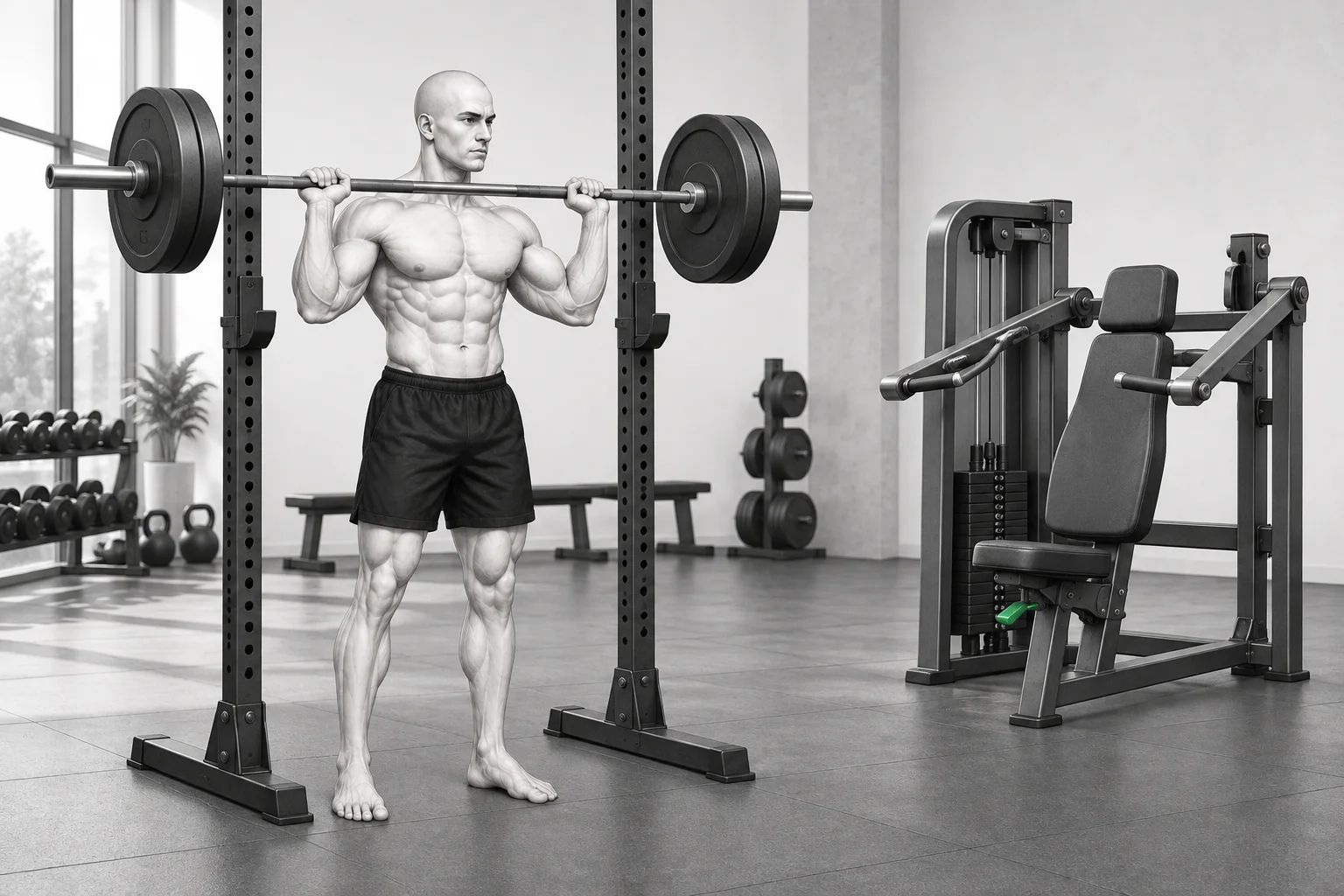
How do the barbell and machine differ?
With a barbell, you guide and stabilize the load yourself. On a machine, the handles follow the mechanism set by its manufacturer: you can adjust the seat but cannot redesign its path. The backrest may reduce trunk stabilization demands. These are differences in the task, not an automatic ranking of exercise quality.
For a broader view, read the guide machines versus free weights. Here, the decision concerns only the overhead press.
What does the research on shoulder presses show?
A crossover study in eight experienced male bodybuilders compared seated barbell and machine presses in front of and behind the head. Researchers measured each variation’s own maximal strength and several muscles’ electrical activity during short sets. In that protocol, parts of the deltoid contributed more to stabilization with the barbell. The study did not test a standing press or measure muscle growth after a training program or injury risk.
A 2023 meta-analysis combined thirteen studies comparing free-weight and machine training over at least six weeks; five reported hypertrophy outcomes. It detected no overall difference in muscle growth. It did not compare only these two shoulder press variations. Strength gains depended more on the exercise used for testing.
A methodological paper on electromyography explains that higher electrical activity during a set has not been validated as a predictor of greater long-term hypertrophy. Do not choose the barbell solely because a muscle appears more active in a graph.
Which variation fits your goal?
| Your goal | Practical choice | What to check |
|---|---|---|
| Improve the barbell press | Barbell | Repeatable path and technique |
| Do shoulder sets on a guided path | Machine | Seat setting and comfortable range |
| Build muscle without a barbell-specific test | The variation you can perform consistently | Quality sets and tracked progress |
This table is a decision aid, not the direct result of a trial that ranked barbell and machine presses for every goal. If a machine path does not suit your proportions, try another station or variation. The guide to adapting exercises to body proportions gives useful adjustment criteria.
How should you set up and perform each version?
For the barbell press, start with the bar in front of your face, keep your forearms under the load and press while clearing your head without turning it into an incline press. Set the rack so you can unrack and rerack without unnecessary effort.
On the shoulder press machine, adjust the seat so you can grip the handles at a height you control and keep your back on the backrest when the machine has one. Use a light trial set to check that your shoulders and hands follow the levers naturally; do not force a path that makes you shift your torso.
These are practical technique cues. The direct study used specific equipment and settings; it does not validate one universal seat height or movement path. If you change machines, start again with an appropriate weight.
How do you track progress without mixing up weights?
Keep the same variation for several workouts. Log the exact exercise, weight, reps, number of sets and machine setting when relevant. Compare your first set with the first set of a similar workout at a comparable range of motion and effort. A higher number on the machine does not prove your shoulders produced more force: lever arms and load transmission vary between machines.
To interpret these records, use the guide to measuring strength-training progress. If handling the barbell is your only obstacle, dumbbells offer a third variation to test and track separately.
Sources and methodology
The direct comparison is a small acute study in experienced men; the meta-analysis covers many exercises, not only shoulder presses. The selection and setup advice is practical guidance, not proof that one version is best for every lifter.
Frequently asked questions
Does a machine train the shoulders less?
The evidence does not support that conclusion. A machine changes the path and stabilization demands. A different electrical signal in one set is not enough to rank long-term muscle growth.
Can I compare barbell and machine weights directly?
No. The displayed weight, levers and path can differ. Keep separate histories for each variation and, where possible, each machine.
Is a barbell essential for bigger shoulders?
No. The free-weight versus machine meta-analysis found no general hypertrophy advantage. Choose a variation you can perform and progress consistently.