What Is a Starting Weight?
The starting weight is the first working load you can repeat with sound technique on a specific exercise. It is not a warm-up load, your maximum, or a universal percentage of your body weight.
It changes with the exercise, variation, range of motion, machine, setup, and your experience. Each movement therefore needs its own trial:
What the evidence shows: several loading ranges can build muscle, while heavier loads favor maximal strength to a greater extent. A network meta-analysis covering 178 strength studies and 119 hypertrophy studies found that every resistance-training prescription studied improved outcomes compared with no exercise, with the best strength response from higher loads. Practical guideline: a beginner does not need to lift heavy in the first workout to find a useful working weight.
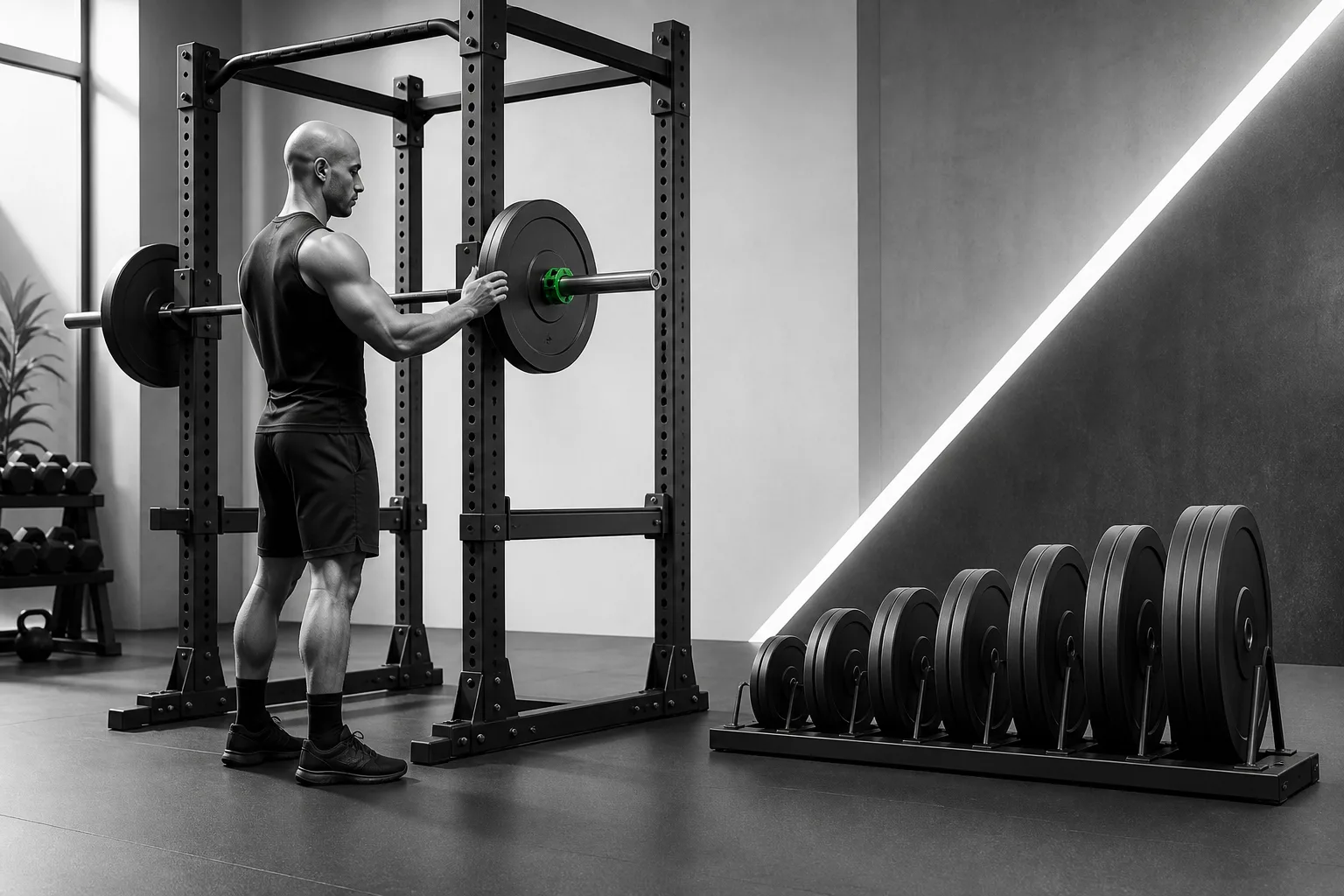
How Do You Find the Right Starting Weight?
- First choose a rep range, such as 8 to 12.
- Perform progressively heavier warm-up sets without turning them into hard sets.
- Choose a deliberately conservative trial weight.
- Complete the bottom of the range with the same range of motion on every rep, then stop.
- Estimate how many clean reps you had left and adjust by one increment only.
The 2026 American College of Sports Medicine position stand, based on 137 systematic reviews, states that high effort is useful and that about 2 to 3 reps in reserve may be sufficient, without training to failure. Starting at 3 to 4 RIR when learning a movement is a more conservative practical guideline here, not a mandatory scientific threshold.
What depends on you: your coordination, body proportions, equipment, and readiness that day. The first weight is a hypothesis to test, not a verdict on your ability.
How Should You Adjust the Weight After the First Set?
For an 8-to-12-rep range, complete 8 clean reps and then use this table. Rest before another attempt so that breathlessness does not limit the set before the target muscles do.
| Result at 8 Reps | Decision for the Next Attempt | Why |
|---|---|---|
| 5 RIR or More | Add the Smallest Increment | The weight is probably too light for the planned working set |
| 3 to 4 RIR | Keep the load | Good margin for learning and repeating the movement |
| 1 to 2 RIR | Reduce by one increment if the technique is still new | The weight may work, but leaves little room for learning |
| Fewer Than 8 Reps or Technique Breaks Down | Reduce by One or Two Increments | The set exceeds the target effort or is no longer comparable |
RIR remains an estimate. In a study of 141 lifters, prediction error ranged from about 2.6 to 3.4 reps depending on the exercise and tended to decrease with experience. A beginner should therefore combine RIR with technical consistency instead of expecting artificial precision.
Example: How Do You Recalculate After a First Attempt?
Your squat target is 8 to 12 reps. After warming up, you try 40 kg, complete 8 clean reps, and estimate that you had at least 5 left. The smallest available increase is 2.5 kg in total, so you try 42.5 kg after resting.
Checked calculation: 2.5 ÷ 40 × 100 = a 6.25% increase. This percentage results from the available equipment increment; it is not a universal rule. At 42.5 kg, you complete 8 reps at about 3 RIR, so keep that weight for the remaining working sets.
On a machine, apply the same logic with the smallest available plate. With light dumbbells, one increment may be a proportionally large increase, so keep the lighter weight and add reps first. The guide to progressive overload explains how to progress from this first baseline.
Do You Need to Test Your 1RM to Choose a Weight?
No. A beginner can choose a working weight with a submaximal set without attempting the heaviest possible single rep. A systematic review with meta-analysis found no overall advantage to reaching failure for strength or muscle gains in young adults, although the available studies and subgroup analyses warrant caution.
Use the e1RM calculator only after a recent, sufficiently demanding set performed with stable technique. Do not treat a set stopped at 4 RIR as a maximal effort: the estimate would be too uncertain to prescribe all of your loads precisely.
How Do You Validate the Weight Over the First Three Workouts?
- Keep the same exercise, variation, and setup.
- In your workout log, record the load, reps, sets, and at least the RIR of the final set.
- Keep the weight while your technique becomes more consistent and you remain within the planned rep range.
- Add the smallest increment when every set reaches the top of the range at the target RIR.
Do not copy another lifter’s weight, choose a load from body weight alone, train to failure to ‘check’ it, or change the load, variation, and range of motion at the same time. A starting weight works if it produces clean sets that you can compare and progress.
Sources and methodology
The available evidence supports a simple approach: several loading ranges can work, high effort does not require failure, and RIR estimation improves with experience. Keeping 3 to 4 RIR on the first attempt remains a conservative practical guideline.
Frequently asked questions
What Weight Should a Complete Beginner Use?
Choose a deliberately light weight, complete the bottom of the planned range, and keep about 3 to 4 clean reps in reserve. Then adjust by one increment instead of trying to find the perfect weight on the first attempt.
Should you use the same weight for every set?
Yes at first, provided your reps stay within the range and your technique remains stable. If the first set was clearly too heavy or too light, adjust by one increment before continuing.
Should You Test Your 1RM Before Starting a Program?
No. A submaximal set is enough to find a working weight. Estimated 1RM becomes an optional reference after a demanding, well-executed set.
When Should You Increase Your Starting Weight?
After the first few workouts, it is no longer simply a starting weight. Increase it when every set reaches the top of the range with the planned technique and RIR.
Should Your Starting Weight Be the Same for Every Exercise?
No. Every exercise, machine, range of motion, and variation needs its own trial. A weight does not transfer directly from the squat to the bench press or from one machine to another.