What is progressive overload?
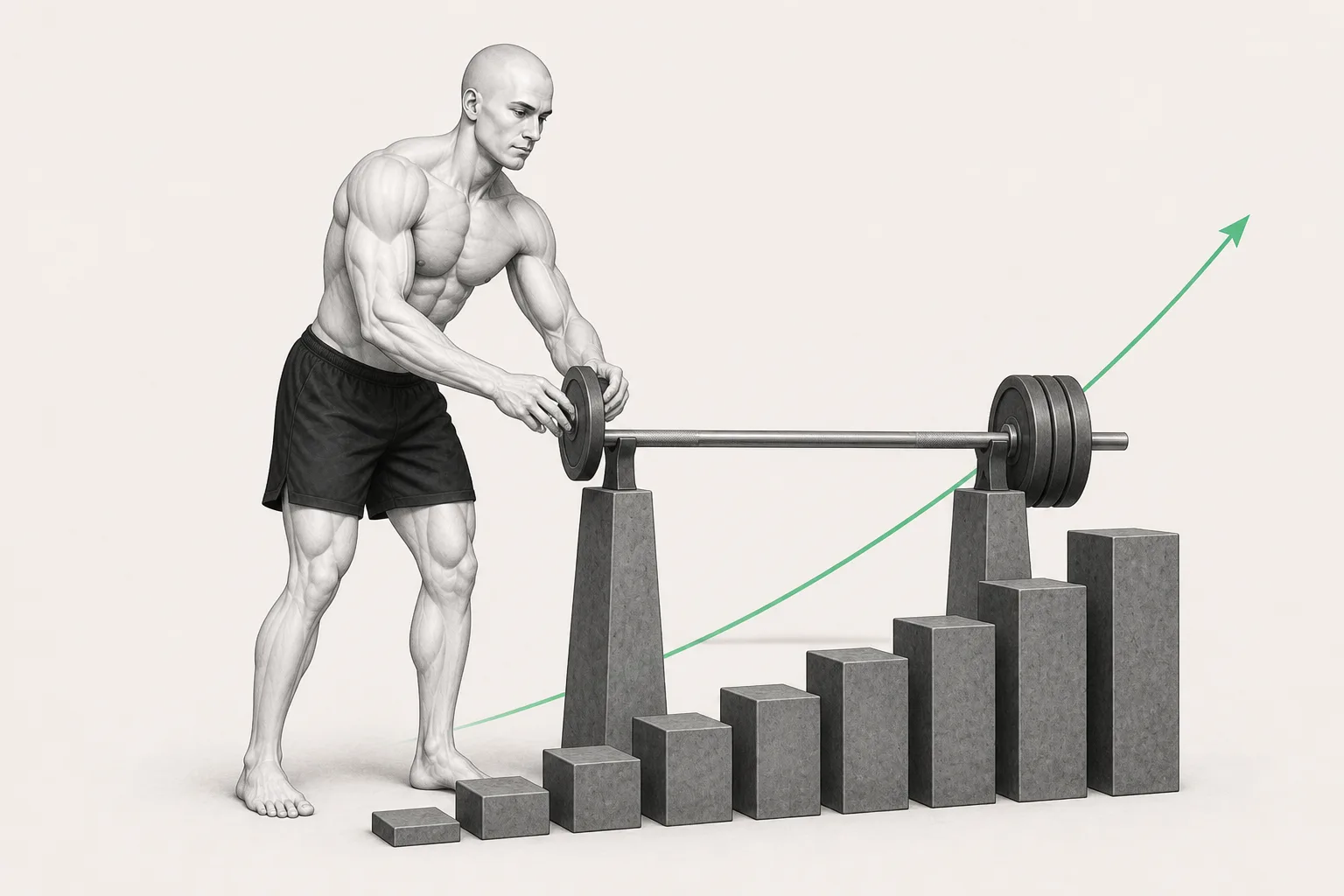
Training must remain demanding enough to drive adaptation. As you become stronger, work that was once difficult becomes easier; progressive overload gradually raises the demand so progress can continue.
The increase does not need to be linear or happen in every workout. Judge progress across several weeks with the same technique and sufficiently similar conditions.
Which variables can you progress?
| Variable | Example | When to use it |
|---|---|---|
| Reps | 8, then 9, then 10 with the same load | The simplest everyday variable |
| Load | 70 kg, then 72.5 kg | When you reach the top of the rep range |
| Sets | 3, then 4 sets | When current volume is no longer enough and recovery remains good |
| Range of motion | The same load through a fuller range of motion | To improve quality before adding load |
| Control | Less momentum and a more stable path | When a heavier load was masking poor execution |
If you do not yet have a performance baseline, start by choosing a starting weight with a controlled trial set, then apply these progression methods in later workouts.
How do you use double progression?
Choose a range, such as 8 to 12 reps. Keep the same load until you reach 12 reps on every set with the planned RIR. Use the guide to rep ranges for muscle growth to choose the right range for each exercise. Then increase the load slightly and return to 8 to 10 reps.
Example: For 3 × 8–12 on a row, once you complete 12, 12, and 12 reps at 2 RIR, add the smallest available load. The next workout might return to 9, 9, and 8 reps.
This method works with machines, dumbbells, and bodyweight exercises by adjusting the relevant difficulty variable.
When should you increase the load?
Increase the load once every set reaches the top of the range with the same range of motion and a consistent effort margin. An increase of 1 to 2 kg on an isolation exercise or 2.5 to 5 kg on a compound movement is often enough.
If your gym does not offer small load increments, add reps first. Available evidence shows that progressing through load or reps can produce similar adaptations over a training cycle.
If you use a 50 mm Olympic bar, fractional plates let you create smaller jumps without changing your progression method.
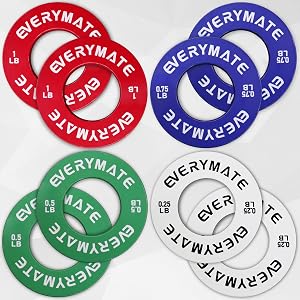 EVERYMATE — Olympic fractional platesAffiliate link · View on Amazon ↗
How do you distinguish progress from compromised technique?
- the same rep should use a comparable range of motion;
- tempo should not suddenly speed up to get through the sticking point;
- help from a partner should not turn an unassisted set into an assisted set;
- rest between sets should remain consistent enough to compare performance.
An extra rep with a shortened range of motion or much more momentum is not the same performance. Record it separately instead of treating it as clear progress.
Also compare the exercise in a similar position within the workout: changing the exercise order changes how fatigued you are when you perform the set.
What should you do when performance stalls?
Do not change everything after one workout. First check rest periods, the sleep duration needed for recovery, nutrition, and fatigue level. If the exercise stalls for several weeks, you can temporarily reduce the load, change the rep range, or replace the variation.
Add sets only if your weekly training volume remains recoverable. Progressive overload describes a performance trend; it does not mean every variable must increase at the same time.
Sources and methodology
Progress can come from several variables. The selected research shows that adding reps and adding load are both viable strategies when training remains structured.
Frequently asked questions
Do you need to progress in every workout?
No. Performance varies with fatigue, sleep, and context. Look for a positive trend across several weeks instead of a daily record.
Does adding a set count as progressive overload?
Yes, but only if the set remains productive and recoverable. Increasing reps or load is often simpler before adding volume.
What if the next load increment is too large?
Keep the same load and add reps, use fractional plates if available, or choose a machine with smaller weight increments.
Can you progress without increasing your e1RM?
Yes. Better technique, more reps, a fuller range of motion, or greater volume tolerance are also meaningful forms of progress.