How many hours of sleep should you aim for?
What the evidence shows: according to the joint recommendation from the American Academy of Sleep Medicine and Sleep Research Society, adults should regularly sleep at least seven hours for their health. The consensus statement on sleep in athletes presents 7 to 9 hours as an appropriate range for healthy adults while rejecting a one-size-fits-all rule.
Practical guideline: start by giving yourself an eight-hour sleep opportunity, then adjust. Time in bed is not exactly time asleep: if you take thirty minutes to fall asleep and spend eight hours in bed, you have not necessarily slept for eight hours.
Key point: seven hours is a general health threshold, not a guarantee of optimal recovery. A trainee may need more depending on age, sleep debt, training load, and daily constraints.
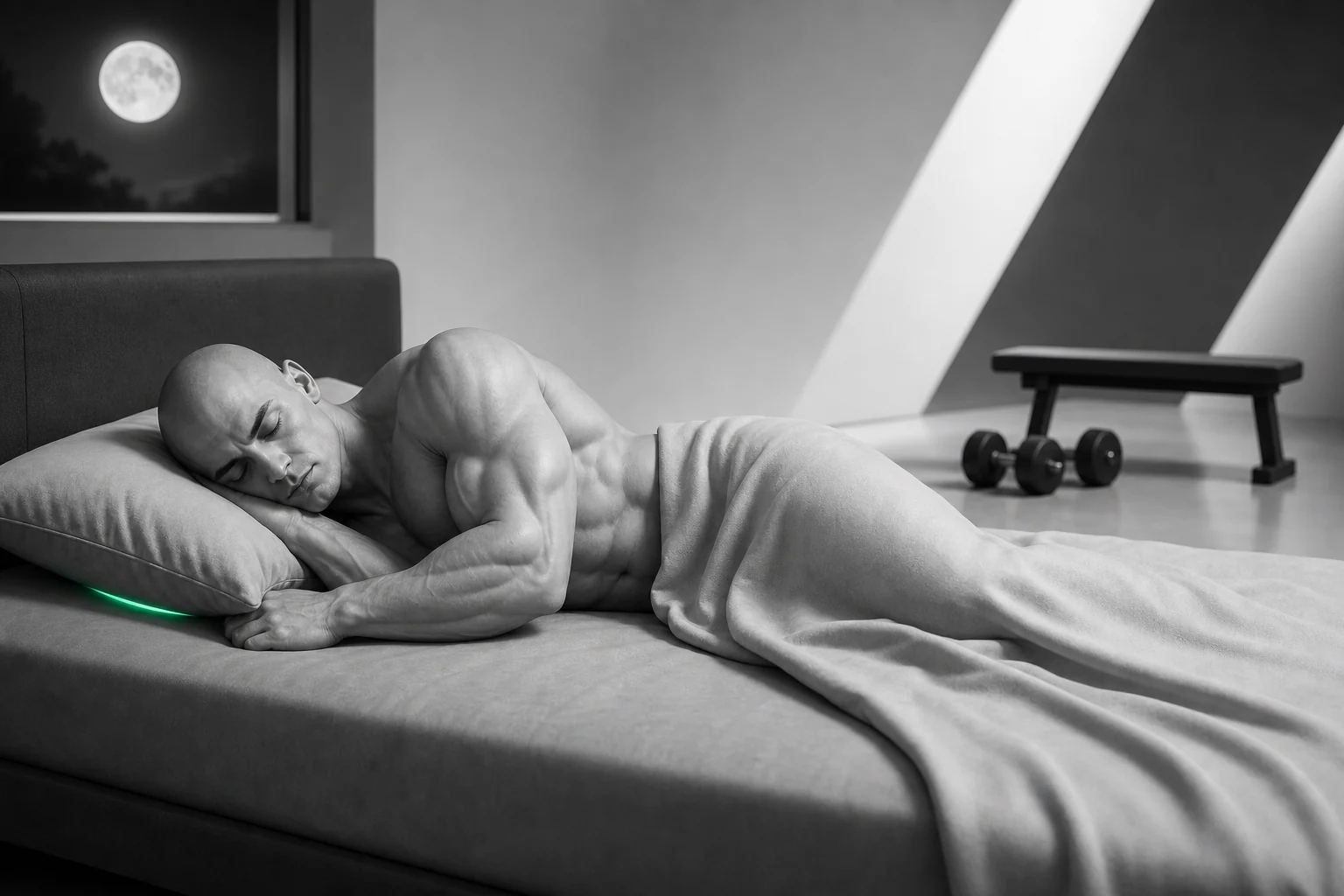
Does sleep loss reduce strength?
Often, but not identically after every poor night. A meta-analysis of 69 publications found an average negative effect of acute sleep loss across every performance category studied, including strength and strength endurance. Effects were more consistent after total deprivation or early waking, especially when testing occurred later in the day.
The evidence specific to strength training is more limited. A systematic review of 17 studies, all rated moderate or weak in overall quality, indicates that several shortened nights can reduce strength in multi-joint movements. One sleepless night did not consistently reduce maximal strength.
What depends on the trainee: exercise type, workout timing, motivation, and accumulated short nights change the response. Do not treat one average workout as proof that your program has stopped working.
Does sleeping more directly build more muscle?
No precise amount of muscle gain can be assigned to each additional hour of sleep. Long-term trials directly linking a sleep range to hypertrophy from a strength-training program remain insufficient.
A crossover study in 13 young adults did observe an 18% reduction in muscle protein synthesis after a full night without sleep compared with normal sleep. This is a mechanistic result from an extreme condition, not evidence that a six-hour night removes 18% of your gains.
Useful conclusion: sleep creates better conditions for recovery and repeated high-quality training. It does not replace adequate protein intake, a progressive program, or genuinely challenging sets.
How can you estimate your individual sleep need?
Observe a two-week trend instead of one isolated night. Record lights-out time, wake time, prolonged awakenings, and sleepiness on waking. At the same time, use your workout log to compare performance on the same exercise in a similar position within the workout.
- Choose a realistic, consistent sleep window for fourteen days.
- Keep the program, exercises, and RIR targets as consistent as possible.
- Identify days when warm-ups feel unusually heavy or technique is less stable.
- Compare loads and reps across several workouts, not one isolated record.
- Extend the window by thirty minutes if sleepiness and lower performance keep recurring.
Consumer watches and apps can help track schedules, but the sports consensus highlights their limitations for accurately measuring sleep stages. Use them as trend indicators, not as a diagnosis.
How should you adjust a workout after a poor night?
A short night does not automatically require cancellation. Complete your planned warm-up, then decide based on alertness, technique, and perceived difficulty.
| Situation | Practical decision | What to avoid |
|---|---|---|
| Short night, but normal warm-up | Keep the workout and planned RIR | Attempting a record to ‘test’ readiness |
| Load feels unusual during the warm-up | Slightly reduce the load or one set | Compensating with worse technique |
| Poor alertness and coordination | Choose stable variations or postpone the workout | Training to failure on a complex movement |
| Several short nights and declining performance | Temporarily reduce volume and restore sleep | Adding sets to catch up |
This table is a cautious guideline, not a protocol validated exercise by exercise. Record the result, then return to your usual load when the warm-up and technique feel normal again. If fatigue has accumulated for several weeks, also check whether a deload week is needed.
Can a nap make up for a short night?
A nap can supplement insufficient nighttime sleep and improve alertness, but it does not guarantee full repayment of sleep debt. The sports consensus presents napping as an option when nighttime schedules cannot be extended and cites benefits from 20-to-30-minute naps for some performance outcomes.
Practical guideline: take a short nap early enough in the afternoon that it does not delay nighttime sleep. If you already struggle to fall asleep at night, do not make napping automatic. Regular nighttime sleep remains the priority.
Which habits genuinely improve nighttime recovery?
- keep bedtime and wake time reasonably consistent;
- allow a window compatible with at least seven hours actually asleep;
- cut off caffeine early enough that it does not delay sleep;
- use a dark, quiet, relatively cool bedroom;
- avoid letting late workouts consistently push bedtime back;
- lighten the program instead of sacrificing several nights to fit every workout in.
Sports recommendations favor an individualized approach. Test one change at a time for at least a week: move caffeine earlier, stabilize wake time, or reschedule the workout. This helps reveal which constraint is actually affecting your sleep.
How can you connect sleep and progress without overinterpreting?
Do not judge recovery from one data point. Compare three trends: sleep duration recorded separately, sleepiness on waking, and performance in ShapeVision. If loads or reps decline across several comparable workouts during a period of short nights, restore sleep before changing the entire program.
ShapeVision records sets, reps, and loads for each exercise. Its morphology analysis and personalized program generator complement this log; they do not measure sleep or diagnose recovery. To interpret a plateau, also review the guide to progressive overload.
Sources and methodology
General recommendations establish a minimum duration for health, while research in athletes describes variable responses. Studies on strength and protein synthesis support the importance of sleep but cannot calculate an optimal hypertrophy sleep duration for each trainee.
- Watson et al. (2015) — recommended sleep duration for adults
- Walsh et al. (2021) — consensus on sleep in athletes
- Craven et al. (2022) — meta-analysis of acute sleep loss and performance
- Knowles et al. (2018) — review of sleep and strength in resistance training
- Lamon et al. (2021) — sleep deprivation and muscle protein synthesis
Frequently asked questions
Are six hours of sleep enough to build muscle?
One six-hour night does not erase your progress, but regularly sleeping six hours remains below the general recommendation of at least seven. If it keeps happening, first try to extend your sleep window.
Should you sleep nine hours on training days?
Not necessarily. Seven to nine hours is a starting point; your need may rise with sleep debt or a high training load. Focus on sleepiness and the trend in your performance.
Should you cancel a workout after a sleepless night?
Alertness and coordination become the priority. Avoid records and failure on complex movements; choose an easier, more stable workout, or postpone it if execution is unsafe.
Can you catch up on sleep at the weekend?
Sleeping longer can reduce part of the debt, but occasional catch-up does not make irregular schedules equivalent to sufficient sleep every night. Start with a sustainable routine.
Does a fitness watch measure recovery accurately?
It can help track schedules and trends, but it estimates sleep stages imperfectly. Compare its data with sleepiness and performance without treating it as a diagnosis.