What Is Progress on a Bodyweight Exercise?
Progressing on a bodyweight exercise means improving performance on a defined variation: doing more clean reps, keeping the same reps with more in reserve, reducing assistance, using a harder leverage, or adding weight.
Load is not the only useful measure. A knee push-up, a standard push-up and a feet-elevated push-up are three different benchmarks. Likewise, a band-assisted pull-up should not be merged with a strict overhand pull-up.
How to read the log: when the variation, range of motion, or assistance changes, create a new baseline. You can connect the stages, but do not present their rep counts as one continuous trend.
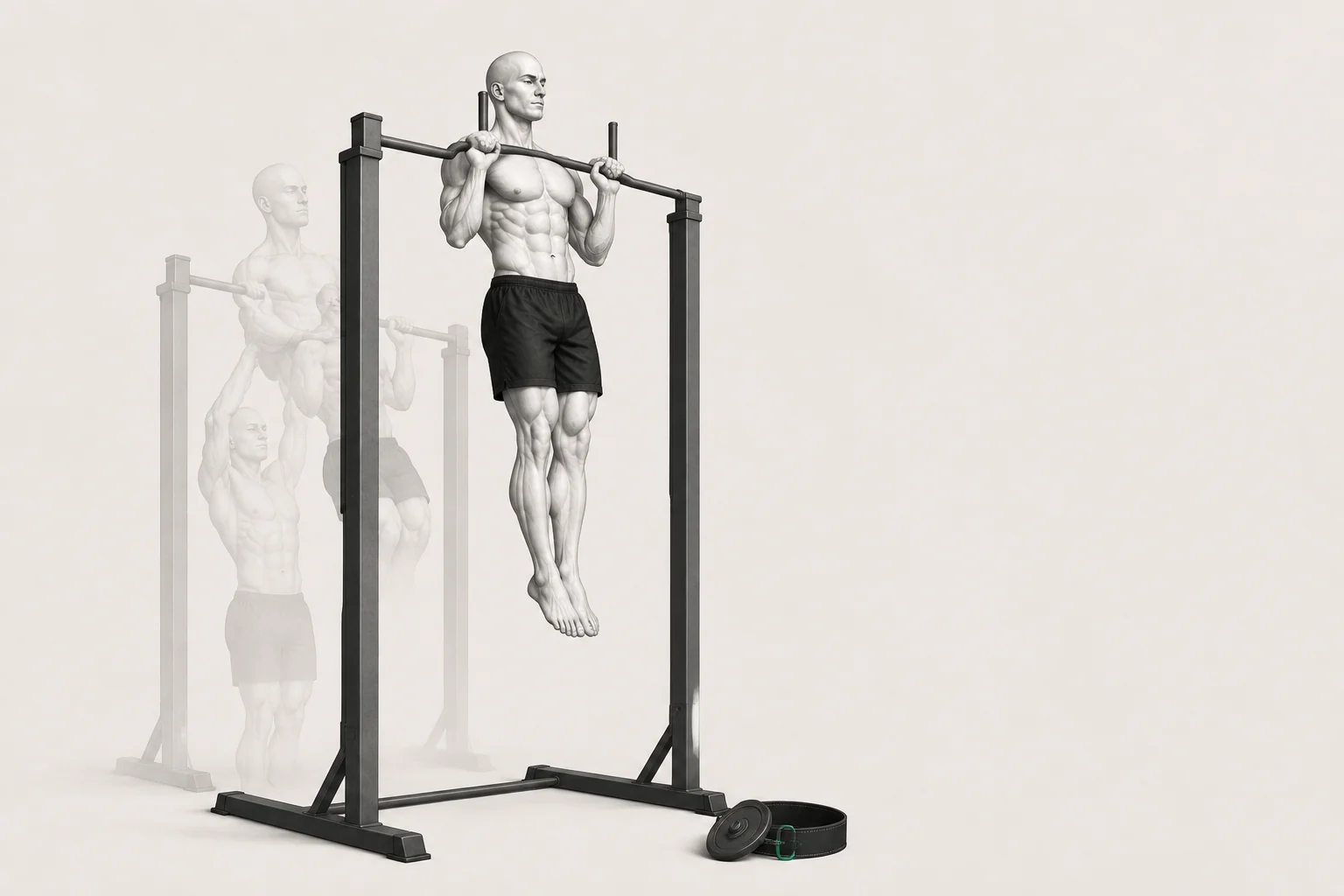
Can Bodyweight Exercises Really Build Strength and Muscle?
Yes, in the movements and populations that have been studied. An eight-week trial in 18 young men compared push-ups adjusted to an intensity close to 40% of bench-press 1RM with low-load bench presses. Both groups improved bench-press strength and triceps and pectoralis major thickness, with no significant difference between groups in those changes.
The sample was small, male only, and limited to push-ups. This result does not prove that every bodyweight exercise replaces its loaded counterpart. It shows that a variation with appropriately adjusted difficulty can provide progressive training without a weight stack.
More broadly, the 2026 American College of Sports Medicine position stand, based on 137 systematic reviews, confirms that resistance training improves strength and muscle mass and finds no consistent effect of equipment type in the comparisons it synthesized. However, it provides no equivalence scale between bodyweight variations and external loads, so each variation should keep its own history.
What Should You Record After Each Set?
| Data | Example | Why it matters |
|---|---|---|
| Exact variation | Strict overhand pull-ups | Avoid mixing two difficulty levels |
| Sets and clean reps | 6, 6, 5 | See total performance and how it is distributed |
| RIR | 2 RIR on the final set | Distinguish progress from simply pushing harder |
| Range of motion and tempo | Arms extended at the bottom, no swinging on the way up | Compare the same execution |
| Assistance or added weight | Medium band or +5 kg | Identify the resistance you actually chose |
| Body weight when relevant | 75 kg that day | Put a lasting change in context |
Body weight provides context, not an exact load conversion: not all of your mass travels through the same path in every movement. On an assisted machine, record the displayed setting and use the same machine because assistance does not convert cleanly between models. The guide to what to record in a workout log helps make this tracking reproducible.
In What Order Should You Increase Difficulty?
- Choose a variation you can repeat with a stable range of motion.
- Set a range, such as 6–10 reps, and a target RIR.
- Add reps while technique and RIR remain comparable.
- When every set reaches the top of the range, change one difficulty variable: less assistance, harder leverage, or a small added load.
- Return to the bottom of the range and build a new history.
This sequence is a practical guideline, not a universal rule. An eight-week trial in 43 trained lifters found broadly similar adaptations when progression came from reps or load across four lower-body exercises. The study did not examine pull-ups, but it confirms that adding reps is a valid form of overload, not merely waiting for “real” progress.
If an extra rep shortens the range of motion or requires more swinging, it does not validate the step. The guide to RIR and muscular failure helps keep effort comparable.
Which Progression Should You Use for Each Exercise?
- Standard push-ups: add reps, then move from an incline to the floor, elevate your feet, or use a stable added load.
- Overhand pull-ups: gradually reduce assistance, reach your target range at body weight, then add a small load.
- Bodyweight dips: keep the same torso angle and depth before adding reps or weight.
- Bodyweight sissy squat: stabilize your support and range first, then add reps or reduce assistance from your hands.
| Equipment | Best suited for | What to check | My pick |
|---|---|---|---|
| EquipmentDip belt | Best suited forPull-ups and dips with weight plates | What to checkChain length, maximum load and comfort on the hips | My pick Eric Flag — dip beltAffiliate link · View on Amazon ↗ Eric Flag — dip beltAffiliate link · View on Amazon ↗ |
| EquipmentAdjustable weighted vest | Best suited forPush-ups, walking, squats and variations where a hanging weight would get in the way | What to checkWeight distribution, close fit and unrestricted range of motion | My pick Eric Flag — 20 kg weighted vestAffiliate link · View on Amazon ↗ Eric Flag — 20 kg weighted vestAffiliate link · View on Amazon ↗ |
| EquipmentAssistance bands | Best suited forLearning pull-ups or gradually reducing assistance | What to checkResistance, length and a consistent anchor point between workouts | My pick PROIRON — assistance bandsAffiliate link · View on Amazon ↗ PROIRON — assistance bandsAffiliate link · View on Amazon ↗ |
What depends on the trainee: the first available progression, your proportions, your level of control, and the available equipment. Choose the easiest change to measure, not necessarily the most spectacular variation. The guide to full or partial range of motion helps define consistent start and end points.
How Do You Read Real Pull-Up Progress?
| Workout | Result | Decision |
|---|---|---|
| 1 | 6, 6, 5 at 2 RIR | Keep the same variation |
| 2 | 7, 7, 6 at 2 RIR | Keep adding reps |
| 3 | 8, 8, 8 at 2 RIR | Top of the range reached |
| 4 | 6, 6, 6 with +2.5 kg at 2 RIR | New weighted baseline |
Checked calculation: workout 1 totals 6 + 6 + 5 = 17 reps; workout 2 totals 7 + 7 + 6 = 20, three more reps at the same RIR. In workout 4, stop comparing only the total because the added weight has created a new baseline.
One better workout may come from being fresher or from exercise order. Confirm the trend across several comparable workouts before drawing a conclusion. If you change variations every week, no amount of data can replace that consistency.
Sources and methodology
Direct evidence on bodyweight progression remains less abundant than evidence on external loads. The selected studies support adjusted variations and progression through reps, without providing a universal scale between every variation.
Frequently asked questions
Should You Count Body Weight as Load?
Record it as context when it changes meaningfully, but do not treat it as perfectly equivalent to external load. The share of body mass moved depends on the movement and technique.
How Should You Log a Band-Assisted Pull-Up?
Record the variation, the band used, reps, and RIR. Keep the same anchor point and do not directly compare two bands whose assistance has not been measured.
When Should You Start Adding Weight to Pull-Ups or Dips?
When every set reaches the top of your range with the planned range of motion and RIR, add the smallest practical load and return to the bottom of the range.
Is a Harder Variation Always Progress?
Only if you can repeat it with defined execution. A spectacular but unstable variation mainly creates a new skill that is hard to compare.
What Should You Do if Your Rep Count Drops?
First check RIR, range of motion, workout order, assistance, and body weight. One drop is not enough; observe several comparable workouts before changing the program.