What Is Full or Partial Range of Motion?
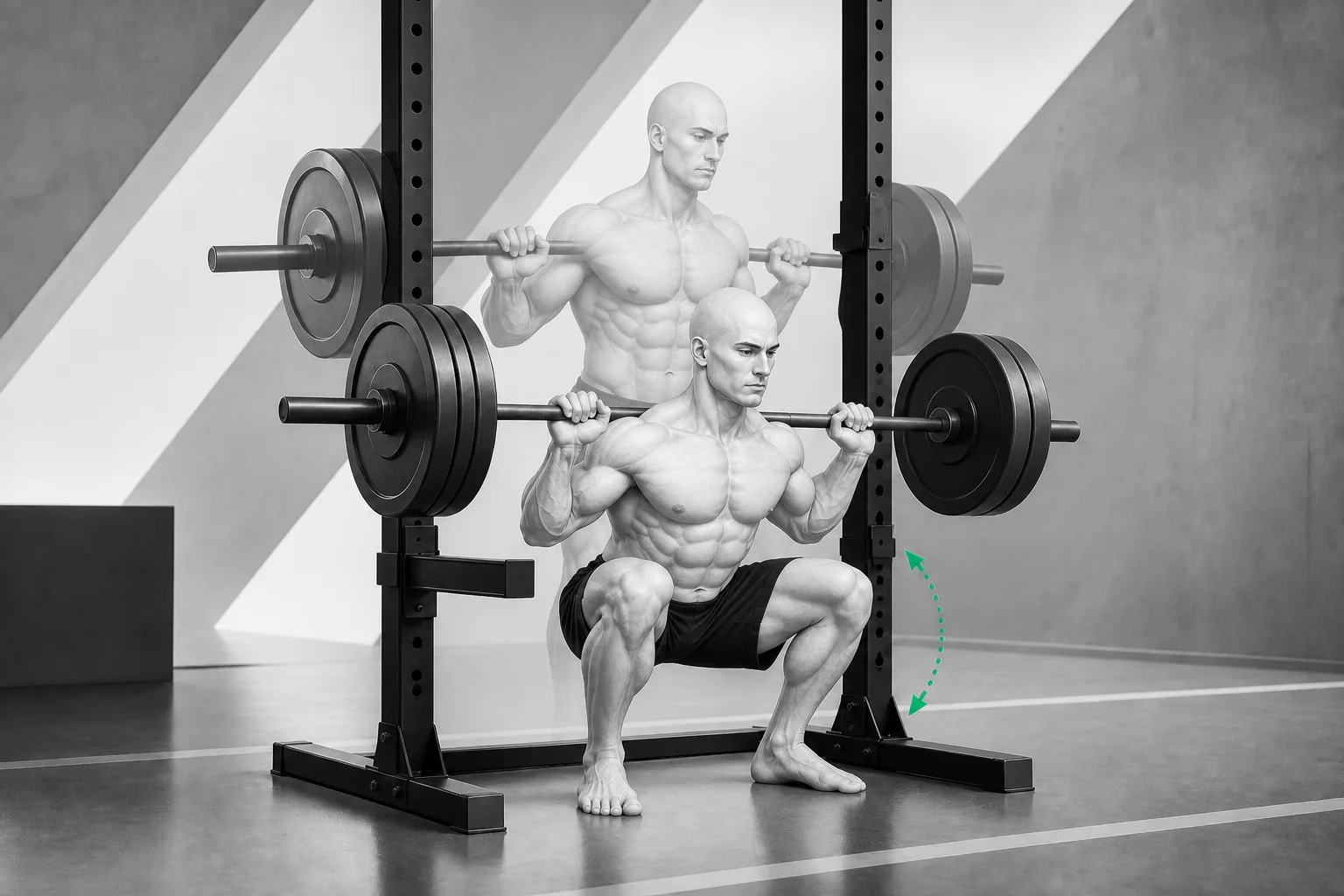
Full range of motion is the largest intentional path planned for an exercise, from the start to the end of the rep, with a stable position and technique. Partial range of motion uses only a defined portion of that path.
A planned partial rep is not a full rep shortened by fatigue. It needs clear boundaries and must remain repeatable. The lengthened portion places the target muscle in a more stretched position, while the shortened portion keeps it more contracted. These zones depend on the movement, not simply on how high the load travels.
Also keep a consistent rep speed : changing range, tempo, and load at the same time makes it impossible to know what actually improved.
What Does the Research Say About Full Range of Motion?
What the evidence shows: the available evidence supports full range of motion as the best general choice. A systematic review and meta-analysis of 16 randomized trials involving 551 adults found an overall advantage for strength and lower-body hypertrophy compared with the shortest partial ranges studied.
Certainty was moderate for several lower-body strength outcomes but low for other measures, and most partial-range protocols mainly trained the muscle in a shortened position. The practical conclusion is not that every partial rep is less effective. It is more precise: if you have no clear reason to limit the movement, start with a controlled full range of motion.
Are Lengthened Partials Useful?
Yes. A lengthened partial trains only the portion where the target muscle remains relatively stretched. In an eight-week trial involving 30 resistance-trained participants, lengthened partials and full reps produced similar changes in arm muscle thickness and unilateral lat-pulldown 10RM.
Another within-participant trial of preacher curls in 13 trained lifters found broadly similar gains, with a small regional advantage for lengthened partials and small strength differences. These samples remain small, and the results do not automatically transfer to every muscle.
A systematic review of eight studies involving 120 adults suggests that training at longer muscle lengths may promote more growth than training in shortened positions, while emphasizing that the evidence is mixed. Practical guideline: use lengthened partials as a targeted option or supplement, not as a universal requirement.
How Should You Choose Range of Motion for Your Goal?
| Situation | Starting Choice | How to Validate It |
|---|---|---|
| Learning an Exercise | Controlled Full Range of Motion | Same Start and End Points on Every Rep |
| Building Strength for a Specific Test | The Test’s Range of Motion | Same Range That Will Be Tested |
| General Hypertrophy | Full Range of Motion | Target Muscle Loaded Through a Large, Repeatable Range |
| Adding Lengthened Partials | Clearly Defined Lengthened Portion | Do Not Turn the Set Into Bouncing or Randomly Shortened Reps |
| Proportions or Machine Constraints | Largest Stable Range Available | Same Setup, Contact Points, and Technique |
What depends on the trainee: your proportions, usable mobility, exercise variation, the equipment’s resistance profile, and the movement goal. The guide to adapting exercises to your body proportions helps distinguish an individual constraint from a simple loss of control.
How Do You Apply This Choice to Each Exercise?
- For the barbell back squat, choose a depth where your contact points, bar path, and pelvis position remain repeatable. A heavier half squat is not a full-squat record.
- For the barbell bench press, keep the same start and end points. A different grip or range of motion creates a new baseline.
- For the machine preacher curl, a lengthened partial is the portion closer to elbow extension, not a few easy centimeters at the top.
- For the standing machine calf raise, define the bottom position and prevent bouncing from replacing controlled movement.
The absolute load often drops when range of motion increases. That is not a regression: the task has changed. Compare each variation with its own history.
How Do You Change Range of Motion Without Losing Your Baseline?
- Define the start and end points before the set.
- Reduce the load if needed to maintain that range.
- In your workout log, keep the same exercise, setup, and range of motion for several workouts.
- If you intentionally change the range of motion, create a new baseline and do not directly compare the loads.
- Then use the rules in the guide to measure real progress.
| Set | Comparison | Interpretation |
|---|---|---|
| 80 kg × 8, Full Squat | Baseline | Baseline |
| 90 kg × 8, Half Squat | Not Comparable | Different Range of Motion |
| 82.5 kg × 8, Same Full Squat | Comparable | Load Up 3.1% |
Checked calculation: (82.5 − 80) ÷ 80 × 100 = 3.125%, or 3.1% after rounding. The improvement is valid only when depth and effort remain comparable.
Sources and methodology
Available reviews favor full range of motion as a general choice, while recent research shows that lengthened partials can produce similar adaptations in some exercises. Results depend on the muscle, the portion of the movement, and the test used.
Frequently asked questions
Should You Always Use a Full Range of Motion?
No, but it is the best general starting point. Deliberately limit the range only for a specific goal, a defined variation, or a position you can control and reproduce more effectively.
Are Partial Reps Bad?
No. They become difficult to interpret when they appear only because fatigue shortens each rep. When planned within a specific portion, they can be a valid method.
Do Lengthened Partials Replace Full Range of Motion?
Not automatically. A few recent studies show similar gains in certain exercises, but their samples are small and results vary by muscle. Use them as a targeted option.
Should You Keep the Same Load When Increasing Range of Motion?
No. Reduce the load if needed to maintain the new range. Then compare that execution with its own baseline rather than with the previous shortened version.
How Should You Log a Change in Range of Motion?
Keep a clear description of the range and the same setup. If the range truly changes, treat it as a new baseline and do not merge its records with the previous execution.