How Do Body Proportions Affect an Exercise?
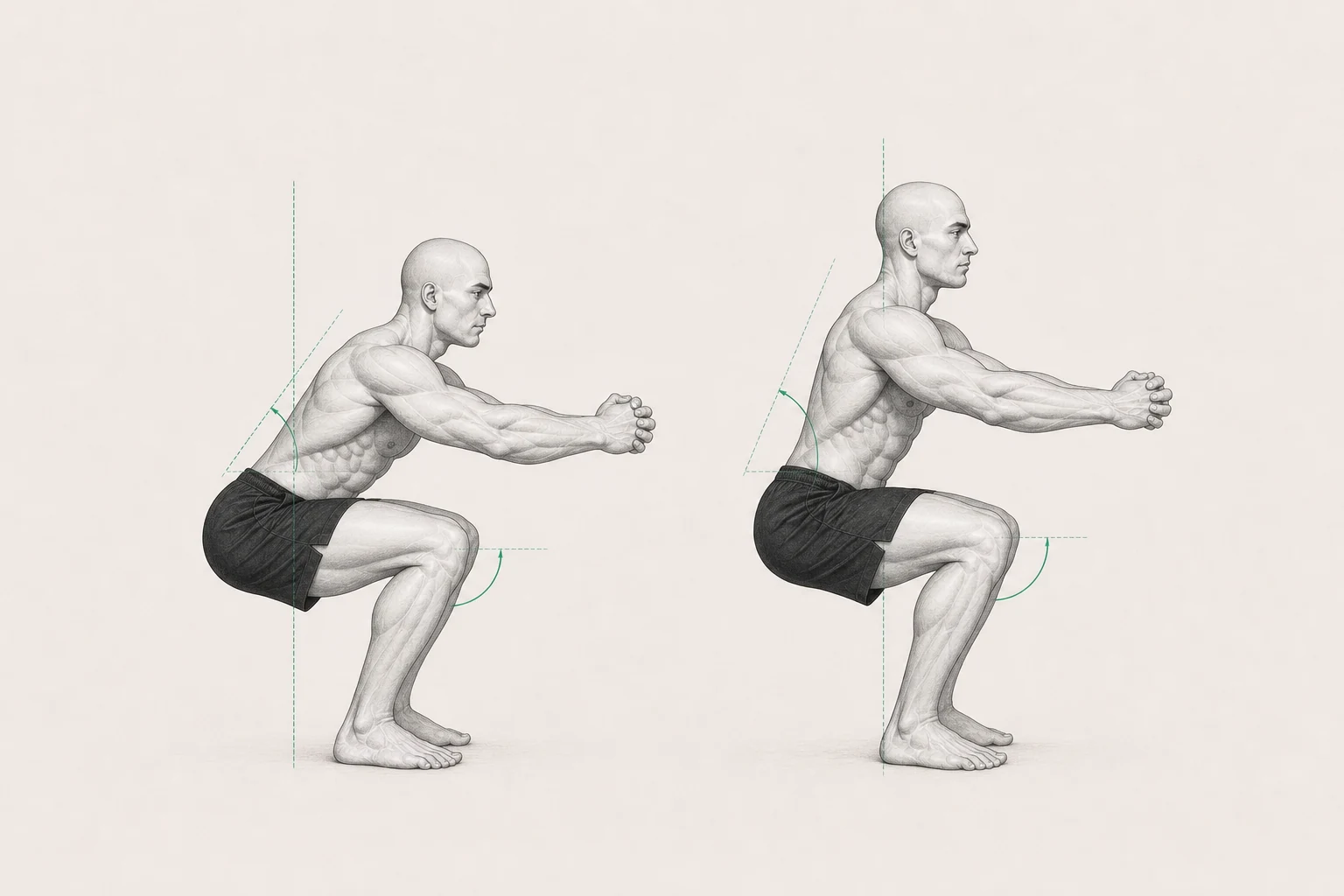
The length of your arms, femurs, and torso changes your leverage and the distance the load travels. Shoulder and hip width, available mobility, and joint structure also affect which positions feel natural.
Two people can therefore perform the same exercise correctly with different torso angles, grip widths, or foot positions. The goal is not to copy one rigid form, but to preserve the intended movement with a stable path.
What Should You Adjust Before Replacing an Exercise?
- Adjust your grip width or foot spacing.
- Try a slight change in hand or foot angle.
- Adjust the seat, backrest, or handle height.
- Reduce the load while you explore a controlled range of motion.
- Film one set from the side and front to check the movement path.
A change of just a few centimeters is often enough. Keep each setting for several workouts so you can compare comfort, stability, and progression.
How Can You Adapt Compound Movements to Your Proportions?
| What you notice | Adjustment to test | Possible variation |
|---|---|---|
| Long femurs in the squat | Slight heel elevation and an adjusted stance | Hack squat or leg press for greater stability |
| Limited ankle mobility | Heel wedge and controlled depth | Smith-machine squat or split squat |
| Long arms in the bench press | Moderate grip and a comfortable touch point | Dumbbells or a converging chest-press machine |
| Shoulder discomfort with a fixed bar | Neutral or semi-neutral grip | Dumbbells, independent handles, or a machine |
| Difficulty stabilizing a row | Reduce the torso angle and load | Chest-supported row |
These options are not automatic prescriptions; they are tests to compare through execution and progression. For the bench press, the guide to the back arch shows how to adjust upper-body support without imposing a maximal bridge.
How Can You Tell Whether a Variation Suits You?
A good variation meets four criteria: you can perform it without pain, the target muscle genuinely limits the set, the movement path is repeatable, and performance improves over several weeks.
Do not judge an exercise by the burning sensation alone. A very stable exercise may feel less dramatic while supporting better progressive overload. Conversely, a heavy load does not compensate for a consistently shortened range of motion or an unstable position.
Should You Always Use the Maximum Range of Motion?
First look for the largest range of motion you can control from a stable position. A full range is a useful starting point, but it still needs to suit your structure, mobility, and the movement you are training.
You can slightly limit an uncomfortable portion of the movement or choose a variation with a better path. The goal is not to force different joints into identical positions, but to load the muscle through a useful, repeatable range.
How Do You Test an Exercise Without Making Random Changes?
- Choose one variation and record the exact settings.
- Keep it for three to four weeks.
- Perform most working sets at 1 to 3 RIR.
- Track stability, comfort, and rep progression.
- Change only one setting or variation at a time.
Keep the exercise if performance improves and it trains the intended area. If it remains unstable or something other than the target muscle limits the set, replace it with a variation from the same movement family.
Sources and methodology
Body proportions and equipment settings affect movement biomechanics. The evidence supports individualized exercise selection and planned variation without treating morphology as an absolute rule.
Frequently asked questions
Are Any Exercises Off-Limits Because of Your Proportions?
Not in general. Some proportions make a variation less comfortable or stable, but setup changes, dumbbells, and machines often let you preserve the same movement pattern.
Should People With Long Femurs Avoid Squats?
No. They may use more torso lean or prefer elevated heels, a different stance, a front squat, a hack squat, or a leg press depending on the goal.
How Do You Choose Between a Barbell, Dumbbells, and a Machine?
Choose the option that offers a comfortable path, good stability, and measurable progression. No type of equipment is superior in every situation.
How Long Should You Test a Variation?
Three to four weeks usually provide enough workouts to move past the initial learning phase and assess both comfort and progress.