
What changes: hip position, not just the seat
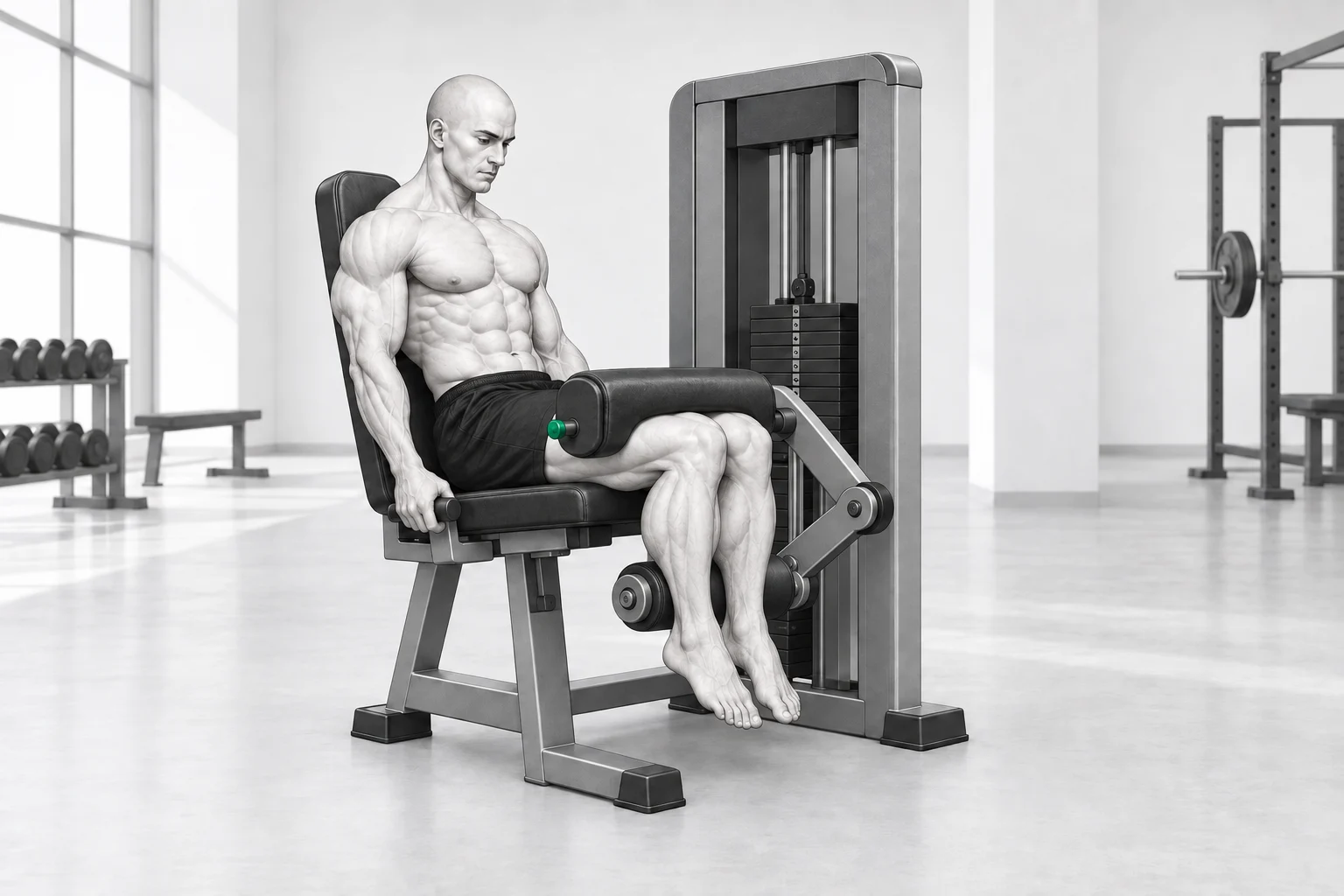
Both variations bend the knee against resistance. Sitting flexes the hip; lying face down involves less hip flexion. Three of the four hamstring components cross both the hip and knee, so sitting places them at a longer length for the same knee angle. The short head of the biceps femoris does not cross the hip.
Compare the exercise guides for the seated leg curl and lying leg curl. The difference is not simply a longer or shorter repetition: hip position also changes.
What does the direct comparison show?
Maeo and colleagues (2021) studied 20 young adults who had not followed systematic resistance training in the previous year. For 12 weeks, each person trained one leg seated and the other lying, twice weekly, using five sets of ten reps per session. MRI measured an increase in total hamstring volume of about 14% seated versus 9% lying.
The advantage concerned muscles that also cross the hip, not the short head. Both variations built muscle. This small supervised trial supports a preference for sitting, not a promise of individual results or a requirement to copy its ten weekly sets.
How should you set up a seated leg curl?
The following are practical guidelines; also follow the instructions for your specific machine. Perform a few light repetitions before choosing your working weight.
- Adjust the backrest to roughly align your knee joint with the machine’s pivot.
- Position the lower roller behind your lower legs, above the heels, not under the soles of your feet.
- Lower the thigh restraint so your thighs do not lift, without painful pressure.
- Keep your pelvis on the seat and your back supported. Bend your knees, then let them straighten under control without slamming the weights.
Do not abruptly lean forward to chase the biggest possible stretch. Start with the intended back support and a comfortable range. If you slide, lift your pelvis or shorten every rep, reassess the setup or weight. Unusual pain is not a training target.
When might lying leg curls be the better choice?
Keep lying leg curls if that is the only machine regularly available, if you can position yourself better on it or if the seated machine cannot align properly with your knees and supports. A theoretically favorable machine that does not fit is not a good trade.
When lying down, place the roller behind the lower legs, keep your hips against the bench and avoid lifting your pelvis to finish the rep. You do not need both variations in every workout. Replacing three lying sets with three seated sets still gives three sets, not six.
To assess your setup, see adapting exercises to your body proportions. To distinguish a deliberate choice from a shortened rep, use the guide to full and partial range of motion.
Can Romanian deadlifts or Nordic curls replace leg curls?
The Romanian deadlift mainly trains hip extension with little knee movement; leg curls train knee flexion. They can complement each other, but swapping one for the other changes the movement and how the work is distributed. Do not assume their sets are identical.
The Nordic hamstring also involves knee flexion, but body weight, leverage and lowering control change its demands. A 2024 trial in untrained men found different growth patterns with Nordic curls and a modified seated variation emphasizing the lowering phase. That protocol was not a standard seated leg curl: it does not provide a simple conversion between the exercises.
How can you tell whether you are progressing?
Treat each machine as a separate baseline. Displayed weights depend on leverage and the resistance system: 30 kg seated is not directly comparable with 30 kg lying. After switching, choose a load that allows stable technique rather than copying the previous number.
As a practical starting point, a range of 10–15 reps with about two clean reps in reserve lets you test the machine without chasing a maximum. It is not the only effective rep range. Keep the same setup, range of motion and a similar place in the workout for several sessions.
Record completed sets in your workout log. Useful progress means adding reps or a small weight increment while maintaining technique and effort level. Do not switch variations simply because one produces a stronger burning sensation.
Sources and methodology
Both trials were read in full. The first directly compares sitting and lying; the second clarifies the limitations of substituting Nordic curls. Setup and selection advice are practical guidelines, not universal prescriptions or promises of injury prevention.
Frequently asked questions
Are lying leg curls useless?
No. They develop the hamstrings and remain a valid choice if you can set them up, control them and progress them. A preference for sitting does not make the other variation ineffective.
Do you need both variations in the same workout?
No. Start with a suitable variation and your planned set count. Adding the other should meet a programming need, not a fear of missing an essential exercise.
Should you lean far forward on seated leg curls?
It is not necessary when starting out. Use the backrest, keep your pelvis stable and control the movement. Research protocols with a deeply flexed hip do not justify randomly modifying a machine.
Can you keep the same weight when changing machines?
Do not assume so. Start with a light set and adjust to your technique and target reps. Then compare each machine with its own history.