How Do You Measure a Starting Grip Width?
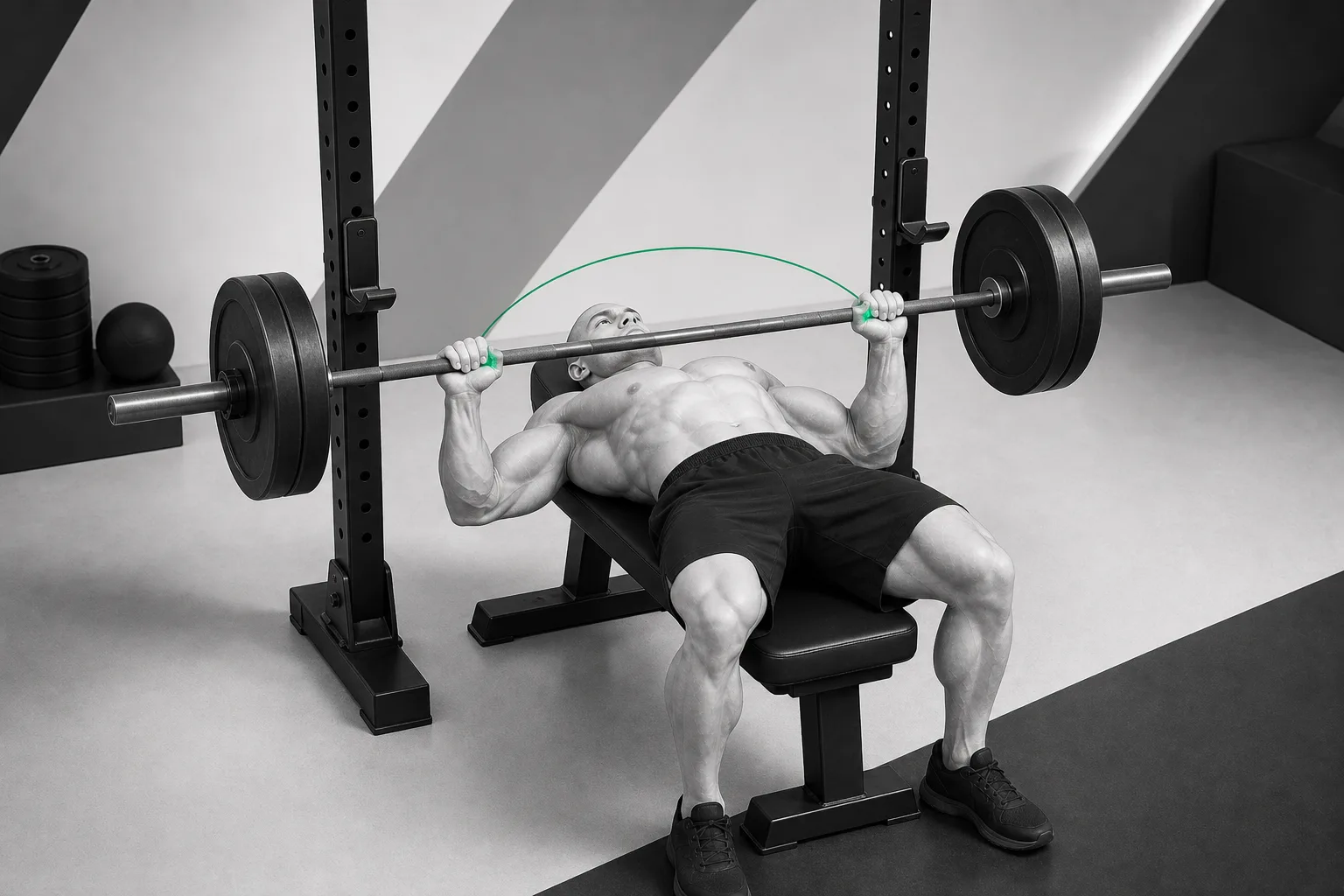
Measure the distance between your acromions, the bony points at the top of your shoulders. Multiply this biacromial width by 1.5 to get a starting distance between your index fingers. For example, 40 cm × 1.5 = 60 cm.
This value comes from categories commonly used in studies: about 1 biacromial width for a narrow grip, 1.5 for a medium grip, and 2 for a wide grip. In a crossover study of 21 trained men, the self-selected grip averaged 1.73 times that width, with substantial variation.
Practical guideline: if you do not want to measure, film a light set from the front. When the bar touches your torso, position your hands so your forearms are nearly vertical and your wrists remain over your elbows. This visual check gives you a starting point, not a universal biomechanical standard.
What Changes With a Wider or Narrower Grip?
A wider grip generally shortens bar travel and increases shoulder abduction. A narrower grip increases the range of motion and the demand for elbow extension. In a 1RM study of 14 trained men, the medium and wide grips allowed more weight to be lifted than the narrow grip; among the muscles measured, only medial triceps activity clearly differed between grip widths.
A biomechanical analysis of 21 techniques in 10 experienced lifters also found higher shoulder reaction forces with wide grips and lower forces with the shoulder blades retracted. These are acute measurements from a musculoskeletal model: they describe mechanical loading but do not prove that any specific width prevents long-term injury.
Do Long Arms Require a Wider Grip?
No. Long arms often increase bar travel, so a slightly wider grip may shorten that range. But shoulder width, chest depth, bar path, and the relative strength of your pecs and triceps also matter.
The evidence does not provide a reliable formula such as ‘arm length = exact hand position.’ A study of 18 trained lifters shows that bench press strength depends on a combination of biomechanical and anthropometric factors. In the study of repetitions at 75% of 1RM, anthropometric characteristics did not consistently explain the number of reps performed with each grip.
What depends on the trainee: with long arms, test the starting grip, then move each hand 2–3 cm outward if your forearms angle inward or the range of motion compromises stability. Move back if your wrists shift, your shoulders lose contact, or the bar path becomes less repeatable. The guide to adapting exercises to your body proportions provides the general method, while theShapeVision physique analysis helps put your proportions into context before you program exercise variations.
Which Grip Should You Choose for Your Goal?
| Goal | Grip to test | Main criterion |
|---|---|---|
| Overall chest hypertrophy | Medium, around 1.5 shoulder widths | Controlled range and target muscle limiting the set |
| Maximum bench press strength | Medium, then slightly wider | Best e1RM with stable technique |
| More triceps emphasis | Close grip, without placing the hands together | Stacked wrists and controlled elbows |
| Long arms | Medium, then gradual outward adjustments | Shorten the range without losing your setup |
| Beginner | A repeatable medium grip | Learn the bar path before optimizing |
These choices are practical guidelines. Studies mainly compare acute performance in small groups of trained men; they do not show that one width produces more long-term hypertrophy. Also keep the same bench press arch during the test: changing the grip and arch at the same time skews the comparison.
How Do You Test Two Grip Widths Without Losing Track of Progress?
- Mark your starting grip using the bar’s reference rings, or measure the distance between your index fingers.
- Film one light set from the front and one from a three-quarter angle to check your wrists, elbows, and bar path.
- Keep the same grip for three workouts, using the same range of motion, rep range, and a comparable RIR.
- Record the load, reps, and RIR in your workout log.
- Then move each hand 2–3 cm and repeat the protocol.
- Keep the grip that offers the best combination of stability, repeatable range of motion, and progression.
Recalculated example: 80 kg × 8 reps gives an e1RM of about 101 kg with the Epley formula: 80 × (1 + 8 ÷ 30) = 101.3 kg. Another grip performed for 82.5 kg × 7 also gives about 101.8 kg. That gap is too small to judge from one workout: compare several exposures with the same e1RM calculator.
Which Variation Should You Use if the Barbell Does Not Suit You?
A grip does not need to rescue a variation that remains unstable. Use the barbell bench press as your reference if its bar path is repeatable. For more triceps emphasis, track the close-grip bench press separately in your history.
If a fixed bar path limits you, try the dumbbell bench press or the converging chest press machine. The barbell floor press intentionally limits the bottom range. These exercises are not interchangeable in your log: keep a separate performance history for each variation.
Also keep a consistent repetition speed. Testing a new grip, range of motion, and tempo at the same time makes it impossible to know which change explains the result.
Which Grip-Width Mistakes Should You Avoid?
- copying another lifter’s hand position without accounting for shoulder width;
- widening the grip only to shorten the range while your setup becomes unstable;
- bringing the hands so close that the wrists bend outward;
- changing grip every workout and comparing loads as if the exercise were unchanged;
- predicting chest growth from a single muscle-activation measurement;
- treating persistent discomfort as a simple setup issue.
A good grip remains repeatable across working sets. If no width allows stable, comfortable execution, replace the variation instead of forcing one position.
Sources and methodology
The sources mainly describe biomechanics, maximal strength, and repetitions performed with different grip widths. They support a measurable starting point and individual testing, not a universal width or a promise of injury prevention.
Frequently asked questions
How Far Apart Should Your Hands Be in the Bench Press?
Start at roughly 1.5 times the distance between your shoulders, then adjust each hand by 2–3 cm. Validate the grip with nearly vertical forearms, stable wrists, and several comparable workouts.
Does a Wide Grip Build More Chest Muscle?
This has not been shown over the long term. A wider grip changes range of motion and joint moments, but acute muscle-activation studies cannot predict greater hypertrophy.
Should You Tuck Your Elbows With a Close Grip?
Let your elbows follow your hand position without pinning them to your torso. At the bottom, keep your wrists over your elbows and use a bar path you can repeat.
Are Long Arms a Disadvantage in the Bench Press?
They can increase bar travel, but they do not determine performance on their own. You can test a slightly wider grip or a dumbbell variation based on your stability and progress.
How Many Workouts Do You Need to Choose a Grip?
Test each width for at least three comparable workouts. One result can vary with fatigue, exercise order, or RIR.