What is repetition tempo?
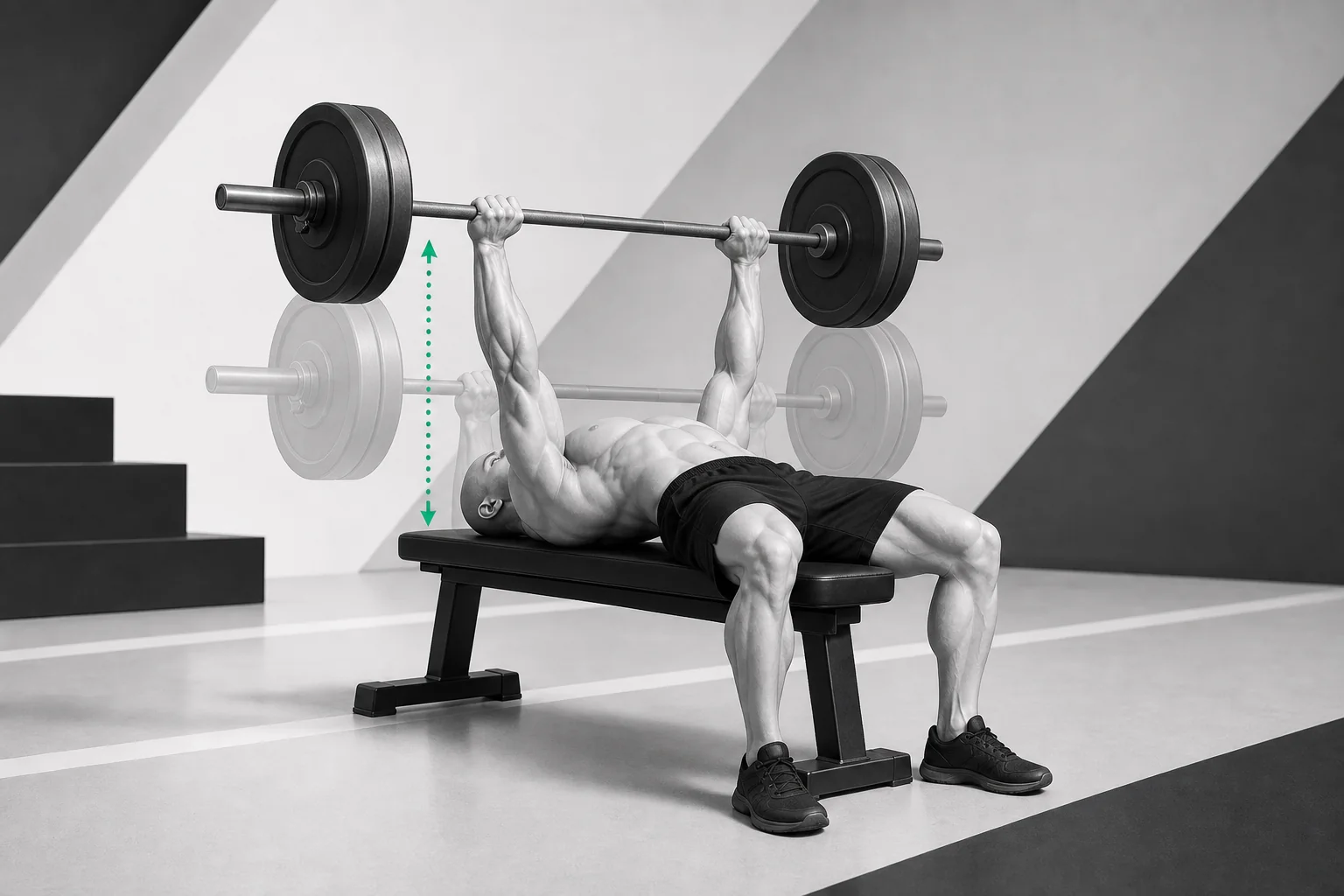
Tempo describes how long each phase of a rep lasts: the lowering or eccentric phase, an optional pause, the lifting or concentric phase, and the transition before the next rep. A cue such as ‘lower for two seconds, then lift with intent’ is often more useful than a complicated code.
Practical guideline: on most exercises, keep roughly one to three seconds of control during the lowering phase, avoid bouncing, and finish the lift without changing the path. This is not a universal cadence: the load, exercise, and goal affect the speed you can actually produce.
Do slow reps build more muscle?
What the evidence shows: a meta-analysis of eight studies found similar hypertrophy gains with reps lasting about 0.5 to 8 seconds when sets were taken to failure. The 2026 American College of Sports Medicine position stand also concludes that time under tension does not consistently change training outcomes.
What remains uncertain: the evidence comes from few studies with different exercises and populations. Deliberately very slow reps—around ten seconds or longer—may be less effective, partly because they require a lighter load, but the evidence remains limited.
Practical application: do not slow a set merely to prolong the burn. Choose a tempo that keeps the target muscle under control while still allowing you to progress in load or reps.
Should you move the load as fast as possible?
For strength, distinguish intent from the speed you observe. You can try to drive a heavy load forcefully even when the bar moves slowly. A meta-analysis of 15 studies and 509 adults found no overall difference in strength gains between fast and moderate-to-slow execution; it found only a trend favoring faster movement with moderate loads.
For power, however, the ACSM recommends a moderate load and a concentric phase performed as quickly as possible. During a regular hypertrophy set, prioritize the movement path: accelerating does not mean bouncing, shortening the range of motion, or losing position.
What tempo should you use for each exercise?
| Exercise | Lowering phase | Lifting phase | Watch for |
|---|---|---|---|
| Barbell bench press | About 2 s, controlled bar path | Intentional drive | Avoid bouncing off the chest |
| Barbell back squat | About 2–3 s, stable footing | Purposeful ascent | Maintain depth and balance |
| Dumbbell lateral raise | About 1–2 s | Controlled lift | Do not swing the dumbbells with your torso |
| Seated leg curl | Controlled 2 s return | Smooth curl | Keep your hips against the pad |
These durations are practical guidelines, not thresholds validated for each exercise. A review of repetition tempo notes that studies rarely isolate the lowering and lifting phases, so no precise pair of durations can be presented as optimal.
Can you compare two sets performed at different tempos?
Not directly. Deliberately slowing a rep often changes the number of reps you can perform and the load you use. For example, 3 × 8 at 80 kg equals 1,920 kg of volume load, while 3 × 8 at 72.5 kg equals 1,740 kg. The arithmetic is correct, but it does not prove the first workout stimulated more muscle: tempo, effort, and range of motion also changed.
In your workout log, treat a new tempo cue separately if it substantially changes the exercise. Then compare load, reps, and RIR across sets performed in the same way. The e1RM calculator provides an additional trend, provided you keep the exercise variation and execution consistent.
How can you test a new tempo without losing track of progress?
- Choose one cue, such as ‘controlled lowering, purposeful lift.’
- Keep the same exercise, range of motion, and rep range.
- Reduce the load only if the new execution requires it.
- Record at least three comparable workouts.
- Decide based on technical consistency, progress, and which muscle actually limits the set.
If the change makes every rep more consistent, an initial reduction in load is not a setback. If you must keep reducing the load without improving control or progress, however, the prescribed tempo is probably too restrictive.
Connect this decision to the guide on progressive overload : the goal is to progress a repeatable execution, not merely to slow the movement.
Which tempo mistakes should you avoid?
- assuming a slow rep is automatically more effective;
- dropping the load and then bouncing to reverse direction;
- counting a shortened rep like the previous ones;
- changing speed every workout without recording it;
- using the same tempo for a squat, a lateral raise, and a power exercise;
- timing tenths of a second at the expense of the movement path.
Useful execution is precise enough to repeat but simple enough to apply during a real set. The rep range, proximity to failure, and progress matter more than an isolated tempo number.
Sources and methodology
The studies distinguish total repetition duration, the speed of each phase, and the intent to move the load. They do not establish a universal cadence; the proposed guidelines make execution controllable and performance comparable.
Frequently asked questions
Should you count seconds on every rep?
No. Count only while learning a new cue. Then use a simple guideline such as ‘controlled lowering, purposeful lift’ and check that your execution stays consistent.
Is a three-second lowering phase better than two seconds?
This has not been shown in general. Both can work if they maintain control, range of motion, and a load that progresses.
Does a rep that slows near the end of a set still count?
Yes, if you maintain the intended range of motion and technique. This involuntary slowdown mainly signals rising effort; do not confuse it with a deliberately slow tempo.
Should you perform the negative phase very slowly?
No. Control it without dropping the load, but there is no need to prolong it systematically. A lowering phase of roughly one to three seconds is a sufficient starting point on most exercises.
Can you use a slow tempo to learn an exercise?
Yes. Temporarily slowing down can help you feel your points of support and movement path. Then return to a controlled natural speed if the tempo reduces the load too much or distracts from technique.