What makes a good bench press arch?
The arch is the space maintained under your lower back while your upper back, pelvis, and feet create stable contact points. A so-called flat-back position still preserves the natural lumbar curve: in the direct study by Bartolomei et al., the flat-back condition only prohibited deliberately accentuating that curve.
Practical guideline: start with a moderate arch by drawing your shoulder blades together and lifting your sternum slightly. Keep your head, upper back, and glutes in contact with the bench, with stable feet. If you have to strain enough to lose a contact point or change position during the set, the arch is too ambitious for that load.
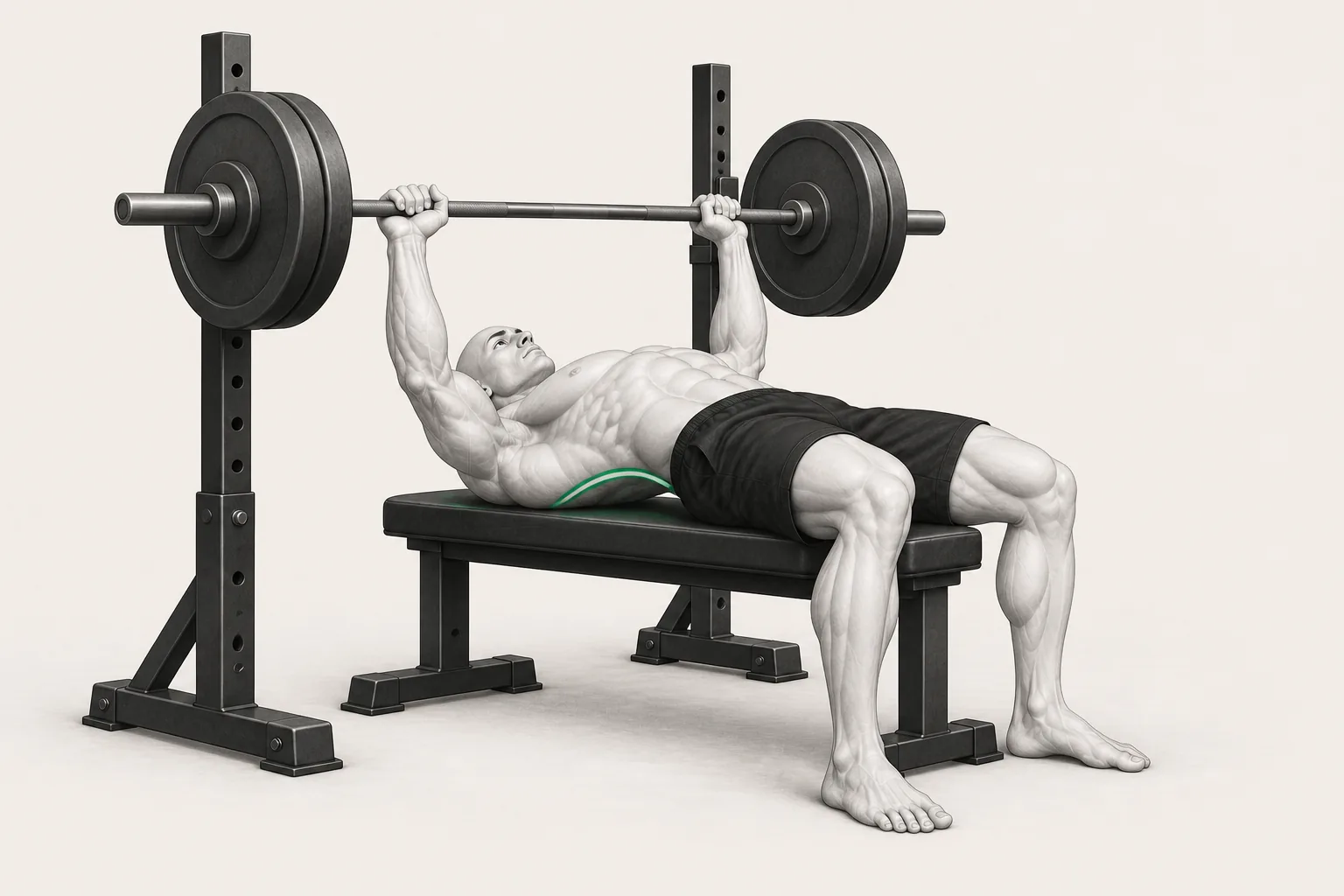
Does a large arch let you lift more weight?
Sometimes, especially for specialists. In 15 highly trained lifters, including 10 competitive powerlifters, the arched technique increased mean 1RM by 4.2 kg, with a confidence interval from 0 to 8.4 kg, and reduced barbell displacement. Measured upper- and lower-pectoralis activation did not differ between techniques.
An earlier study in 11 male powerlifters also found a shorter bar path with the arch, but no significant 1RM difference. Both studies were acute, involved small groups of experienced specialists, and did not measure long-term muscle growth.
The correct conclusion: a pronounced arch can improve leverage and shorten the bar path for some powerlifters. These findings do not prove that it builds more muscle or suits every lifter better.
How do you create a moderate, stable arch?
- Lie down with your eyes slightly behind the bar.
- Place your feet where you can drive into the floor without lifting your glutes.
- Draw your shoulder blades together and keep your upper back firmly on the bench.
- Lift your sternum slightly without trying to raise your abdomen as high as possible.
- Grip the bar, check that your wrists stay stacked over your forearms, and keep those contact points as you unrack.
- Lower to a repeatable touch point, then press without flattening or increasing the arch.
Then adjust your bench press grip width without changing anything else. If you also change your feet, touch point, and grip, you will not know which adjustment explains the difference.
To learn with fewer variables, test the barbell bench press with a moderate load. The dumbbell bench press, the converging chest press machine and barbell floor press are distinct variations: compare each one with its own history.
Should you pin your shoulder blades back to protect your shoulders?
Retracting the shoulder blades changes mechanical loading, but it does not guarantee freedom from injury. A modeling study involving 10 experienced lifters found that a retracted position reduced several calculated shoulder-joint forces and the modeled activity of part of the supraspinatus. The authors also found higher shear forces at other points in the movement.
What the evidence shows: shoulder-blade position changes estimated forces. What is not established: this small, acute modeling study does not prove that a specific arch or retraction prevents injuries. Prioritize a stable, pain-free position that you can maintain with a controlled load.
Which arch should you use for your goal and proportions?
| Situation | Arch to test | How to Validate It |
|---|---|---|
| Beginner | Moderate and easy to reproduce | Stable glutes, upper back, and feet |
| Pectoral hypertrophy | Natural to moderate | Planned range of motion, sets close to failure, and progression |
| General strength | Moderate | Consistent bar path and higher e1RM with the same technique |
| Powerlifting | More pronounced if it remains within the rules | Valid pause, depth, contact points, and load |
| Long arms or a shallow chest | Gradual adjustment, with no universal formula | More stable path without losing contact points |
Arm length and chest depth affect bar travel, but they do not prescribe an exact arch angle. Use the guide to adapting exercises to your body proportions, then keep a defined, comparable range of motion. To emphasize the triceps without artificially changing the main movement, track the close-grip bench press.
Which rules apply in powerlifting competition?
Under International Powerlifting Federation rules, the technical rulebook effective March 1, 2026 requires the head, shoulders, and glutes to remain in contact with the bench, the feet to remain flat, and the underside of each elbow to descend below the top of the corresponding shoulder at the bottom of the lift.
An arch therefore does not remove the required depth. For competition, practice the position with the same pauses and contact points. Outside competition, do not copy a maximal arch for its appearance; choose the setup that serves your goal and remains controllable.
How do you compare two arches without skewing the result?
- Use the same grip, touch point, and pause.
- Test the moderate arch for three workouts first.
- Record the load, reps, RIR, and any loss of a contact point.
- Then test a slightly different setup with the same rep range.
- Compare the trend, not the single best rep.
Three workouts are a practical guideline, not a scientific threshold. The guide to what to record in a strength-training log helps keep comparisons clean. If the arch noticeably changes the range of motion or bar path, record it as a new variation instead of merging the performances.
Sources and methodology
Direct studies of the bench press arch are few, acute, and conducted mainly in experienced powerlifters. They inform performance and biomechanics but do not establish a universal posture for hypertrophy or injury prevention.
- Bartolomei et al. (2024) — flat-back versus arched-back bench press in strength athletes
- García-Ramos et al. (2019) — 1RM and load-velocity profile by back position
- Noteboom et al. (2024) — bench press technique and modeled joint forces
- International Powerlifting Federation (2026) — bench press technical rules
Frequently asked questions
Should your entire back stay against the bench?
No. A natural lumbar curve can remain. The key is to maintain stable contact points: head and upper back supported, glutes on the bench, and feet anchored.
Is a bench press arch dangerous?
Available studies cannot label one specific arch dangerous or protective for everyone. Do not force a painful position, progress gradually, and choose an arch you can maintain without losing your contact points.
Does a large arch reduce pectoral involvement?
In one small, acute study of highly trained lifters, measured pectoral activation was similar with flat and arched back positions. This cannot establish long-term hypertrophy outcomes.
Can you lift your glutes to increase the arch?
No. Keep your glutes in contact with the bench throughout the set. In IPF competition, lifting them invalidates the attempt; in training, it also changes your contact points and makes performance less comparable.
How do I know if my arch is too large?
Reduce it if you lose glute or foot contact, your position changes during the reps, the bar path becomes inconsistent, or the setup causes pain.