How do you choose the number of workouts?
| Frequency | Best for | Suggested format |
|---|---|---|
| 3 workouts | Busy schedule, beginner, or intermediate | Full body |
| 4 workouts | Good balance between volume and recovery | Upper/lower |
| 5 workouts | More specialization and shorter workouts | Upper/lower + push/pull/legs hybrid |
Do not choose five days simply because the program looks more advanced. The number of workouts organizes the work; it does not replace consistency or progressive overload.
Once your training days are set, organize each workout with the guide to exercise order in strength training : the priority movement generally benefits from being placed first.
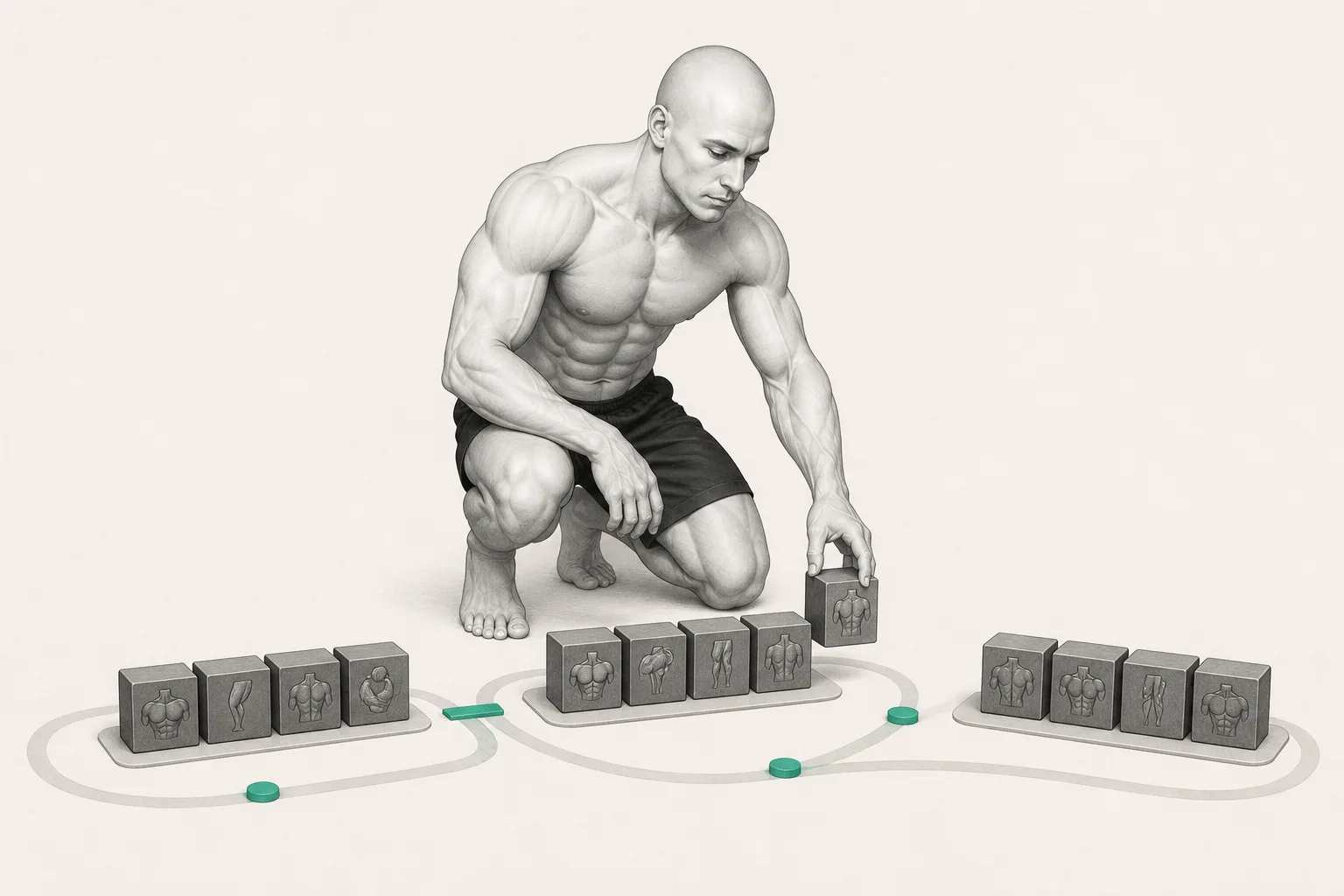
Three-workout strength program
Full-body training works the major muscle groups several times without concentrating all their volume on one day.
| Day | Main exercises |
|---|---|
| Monday · Full body A | Squat, incline press, row, lateral raises, curl |
| Wednesday · Full body B | Romanian deadlift, lat pulldown, overhead press, leg extension, triceps |
| Friday · Full body C | Leg press, bench press, chest-supported row, leg curl, rear delts |
Plan 2 to 4 sets per exercise in most cases. Alternating movements lets you train each area frequently without repeating exactly the same stress.
Four-workout strength program
An upper/lower split gives each muscle two weekly sessions with enough rest between them.
| Day | Focus | Main exercises |
|---|---|---|
| Monday | Upper A | Incline press, lat pulldown, row, lateral raises, arms |
| Tuesday | Lower A | Squat, leg curl, calves, abs |
| Thursday | Upper B | Bench press, row, pullover, rear delts, arms |
| Saturday | Lower B | Romanian deadlift, leg press, leg extension, calves |
This structure works well with a twice-per-week frequency for each muscle and lets you prioritize one area with the first exercise.
Five-workout strength program
A hybrid structure keeps two main weekly sessions per muscle while shortening some workouts.
| Day | Focus | Priorities |
|---|---|---|
| Monday | Upper body | Chest, back, shoulders |
| Tuesday | Lower body | Quads, hamstrings, calves |
| Thursday | Push | Chest, shoulders, triceps |
| Friday | Pull | Back, rear delts, biceps |
| Saturday | Legs | Quads, hamstrings, glutes, calves |
The fifth day should not be used to add volume everywhere. Its main purpose is to distribute sets better and give more room to a priority muscle.
How many sets should these programs include?
Start with about 8 to 12 direct sets per major muscle group, then adjust for your experience and recovery. A priority muscle can gradually move toward 12 to 20 sets while other areas remain closer to maintenance.
Use the guide to sets per muscle and the calculator to check that compound exercises do not create too much indirect work for the arms or shoulders.
How do you progress the program?
- Choose a rep range for each exercise.
- Keep most sets between 1 and 3 RIR.
- Increase reps before load with double progression.
- Take 2 to 3 minutes of rest on the main movements.
- Keep the structure for 6 to 10 weeks before evaluating it.
If a week becomes busy, remove one workout or a few sets instead of abandoning the program entirely. The structure should remain adaptable.
Sources and methodology
At comparable volume, full-body and split routines produce similar gains. Choosing between three and five workouts should mainly improve consistency, volume distribution, and set quality.
Frequently asked questions
Are three workouts enough to build muscle?
Yes. A well-structured full-body program can train each muscle group several times per week and provide all the necessary volume.
Is a five-day program more effective?
Not automatically. It makes distribution and specialization easier, but offers no advantage if the extra workouts reduce recovery or consistency.
Can you move the training days?
Yes. Keep consistent spacing between demanding workouts for the same muscle group and adapt the days to your schedule.
How long should a workout last?
Often 50 to 80 minutes, depending on the number of exercises and rest times. A longer workout is not necessarily more productive.