What does training frequency per muscle mean?
Training frequency is the number of weekly workouts that stimulate a given muscle group. A press can count for the chest and partly for the triceps; a pull can count for the back and partly for the biceps.
Do not confuse it with the total number of workouts. A five-day program may train each muscle only once, while a three-day full-body program can stimulate it three times.
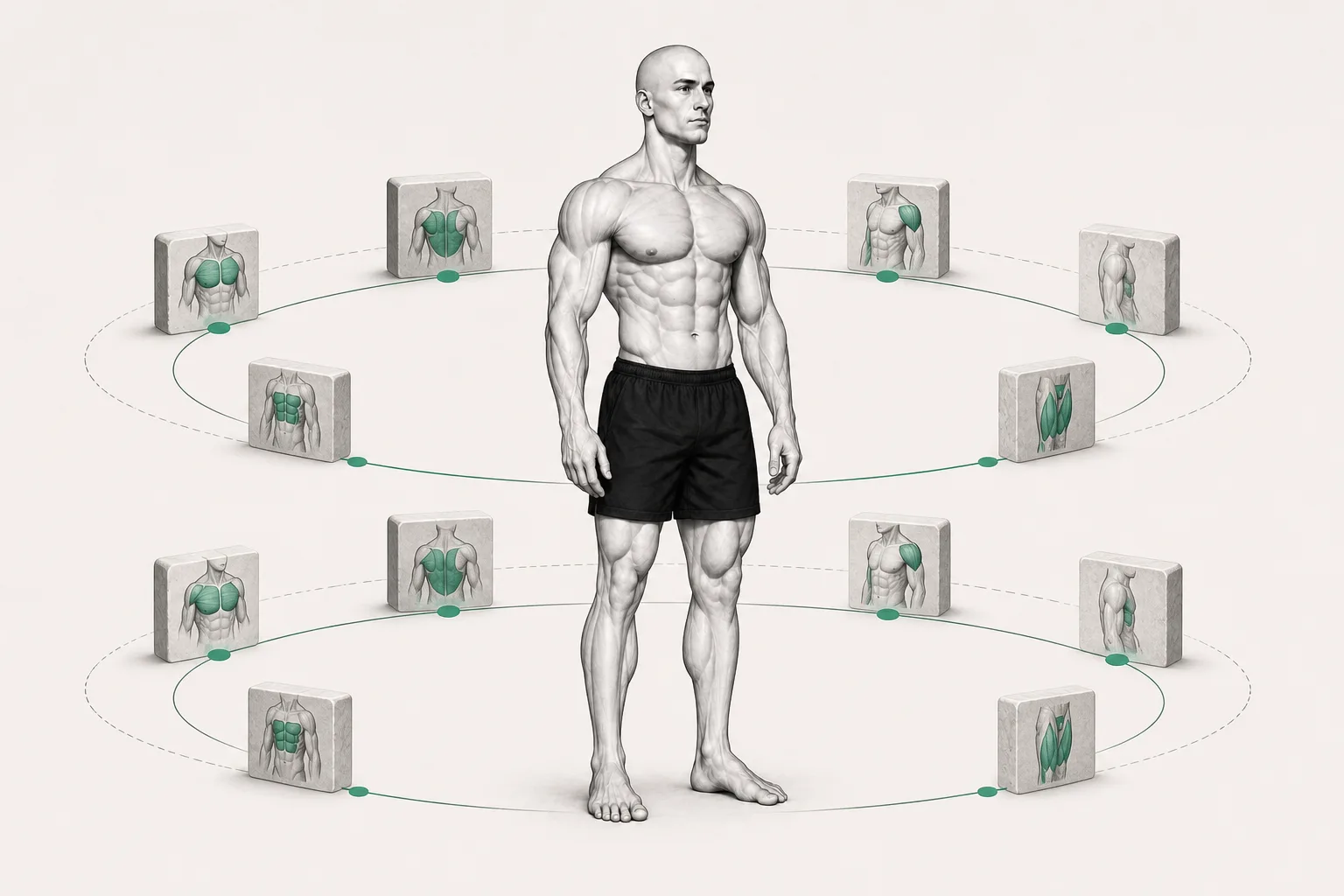
What frequency should you choose in practice?
| Frequency | When it works well | What to watch |
|---|---|---|
| Once per week | Low volume, maintenance, or schedule constraints | The workout may become too dense |
| Twice per week | Versatile choice for most muscles | Distribute indirect work carefully |
| Three times per week | Priority muscle, technique practice, or high volume | Reduce volume in each workout |
| Four times or more | Specialized training with small doses | Local fatigue and overlap |
With weekly training volume held equal, increasing frequency does not automatically produce more hypertrophy. Its main benefit is organizational.
How do frequency and set volume work together?
As weekly volume increases, preserving quality in one workout becomes harder. Use frequency to limit the number of consecutive sets for the same muscle.
| Direct volume | Common distribution |
|---|---|
| 6 to 8 sets | 1 to 2 workouts |
| 10 to 16 sets | 2 workouts |
| 16 to 20 sets | 2 to 3 workouts |
These guidelines complement the guide to sets per muscle. They do not require you to reach the top of every range.
How do you distribute work across two or three sessions?
For 12 chest sets, you can perform 6 + 6 across two workouts or 4 + 4 + 4 across three. For 15 back sets, an 8 + 7 split remains simple; a technique priority may work better as 5 + 5 + 5.
Avoid creating exactly the same fatigue in every workout. One session can include the heavier movement and another a more stable variation or a higher rep range.
Do indirect sets affect training frequency?
Yes. If you train chest on Monday and shoulders on Tuesday, the triceps probably work on consecutive days. Similarly, the biceps receive stimulus in each back workout.
Count these overlaps before adding a dedicated workout. The volume calculator provides a direct total, and you can then account for indirect sets to keep the week realistic.
When should you change training frequency?
Increase frequency if a workout becomes too long, later sets clearly lose quality, or you want more practice with a movement. Reduce it if performance has not recovered by the next workout or your joints accumulate discomfort.
Do not change frequency and volume at the same time. First distribute the same sets differently, observe for two to four weeks, then adjust only if necessary.
Sources and methodology
When volume is comparable, frequency alone has little effect on hypertrophy. It remains useful for distributing sets, practicing movements, and preserving effort quality.
Frequently asked questions
Is training a muscle once per week ineffective?
No. Once per week can work if volume is sufficient and well executed. Twice per week often makes distribution and set quality easier.
Is three times per week always better than twice?
No. At equal volume, a hypertrophy advantage is not clearly established. Three sessions are mainly useful for distributing high volume or practicing a movement more often.
How many days should you leave between workouts for the same muscle?
Often 48 to 72 hours, but local workload matters more than the exact number. A small dose can recover faster than a very high-volume workout.
Do the arms need a dedicated workout?
Not necessarily. Pulls and presses already stimulate them. Add dedicated work only if direct volume remains insufficient for your priority.