How Long Should You Keep the Same Program?
Keep the structure as long as it remains practical and performance continues to improve. Six to twelve weeks often provide enough time to assess a block, but a program has no automatic expiration date.
You can keep some exercises for much longer. Repetition makes technique more consistent and lets you read progressive overload.
What Are Good Reasons to Make a Change?
| Signal | What to verify | Action |
|---|---|---|
| Confirmed plateau | No progress for 3 to 4 weeks despite good recovery | Change the load, rep range, or volume |
| Poorly suited exercise | Discomfort, instability, or the target muscle rarely limits the set | Choose a variation from the same movement family |
| New goal | Another area or quality becomes the priority | Change exercise order and redistribute volume |
| New constraints | Fewer days, less time, or different equipment | Rebuild the weekly split |
| Declining adherence | The routine repeatedly causes you to skip workouts | Simplify or refresh part of the program |
What Does Not Justify Replacing Everything?
- one bad workout;
- a lack of soreness;
- a new routine you saw on social media;
- the urge to replace an exercise whenever it becomes difficult;
- one busy week that temporarily reduces performance.
In these situations, keep the program or use a deload week if overall fatigue has genuinely accumulated.
What Should You Check Before Calling It a Plateau?
- Are your sets performed with the same range of motion and RIR?
- Are your rest periods long enough and consistent?
- Do body weight and protein intake support the goal?
- Do your sleep and stress levels allow you to recover?
- Did the weekly training volume increase too quickly?
A program cannot fix poor recovery by itself. Address the variable that changed first.
How Do You Change a Program Without Starting Over?
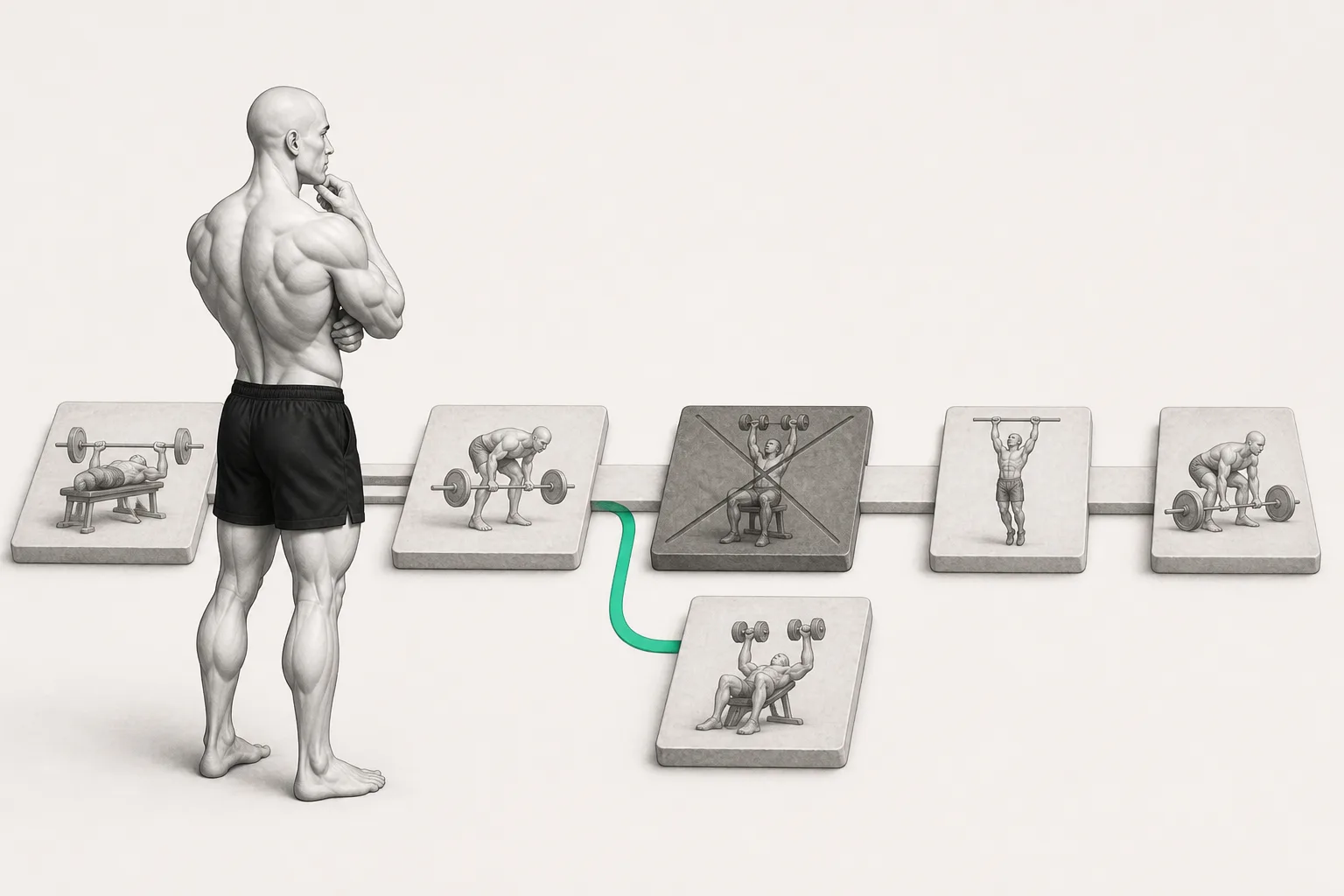
Change one layer at a time. Replace a poorly suited exercise with a movement for the same muscle, or keep the exercise and change its rep range. Reduce or increase volume only if recovery requires it.
| What stays | What changes |
|---|---|
| Movement pattern | Barbell to dumbbells or a machine |
| Priority muscle | Exercise moved earlier in the workout |
| Weekly split | A different rep range |
| Productive exercises | Remove redundant movements |
How Should You Start the New Program?
Start at 2 to 4 RIR with volume slightly below your maximum recoverable level. Record the settings for new variations, then rebuild loads over two weeks instead of immediately chasing your old exercise performance.
If only your availability changes, choose one of the structures in the guide to three- to five-day workout programs. You will preserve more exercises and performance references.
Sources and methodology
Adaptations remain specific to the movements you train. Structured variation can be useful, while excessive random rotation makes learning and progression harder.
Frequently asked questions
Should You Change Programs Every Two Months?
No. Two months is a useful time to assess a program, not a deadline for replacing it. Keep what is progressing and change only what has become limiting.
Should You Change Every Exercise at Once?
No. Keeping part of the program preserves technical reference points and lets you compare performance during the transition.
Does a Plateau on One Exercise Require a New Program?
No. Adjust that exercise first: load, reps, rest, RIR, or variation. The rest of the program can remain unchanged.
Can You Make Changes Just to Restore Motivation?
Yes, if monotony is hurting consistency. Replace a few movements or change the weekly split without making the entire selection random.