Does Cardio Really Make You Lose Muscle?
Concurrent training means performing endurance and strength training within the same training period. Cardio does not automatically “burn” muscle. The useful question is whether the amount and placement of endurance work reduce the adaptations produced by your lifting sessions.
What the evidence shows: a systematic review and meta-analysis of 43 studies and 1,090 participants found no significant reduction in whole-muscle hypertrophy or maximal strength when cardio and strength training were combined, compared with strength training alone. The programs lasted at least four weeks and involved healthy adults.
This average result does not mean that any amount of cardio suits everyone. Many studies were short and the protocols varied. It mainly shows that a beginner does not have to choose between cardiovascular fitness and muscle. The World Health Organization guidelines also combine aerobic activity with muscle strengthening because they provide different benefits.
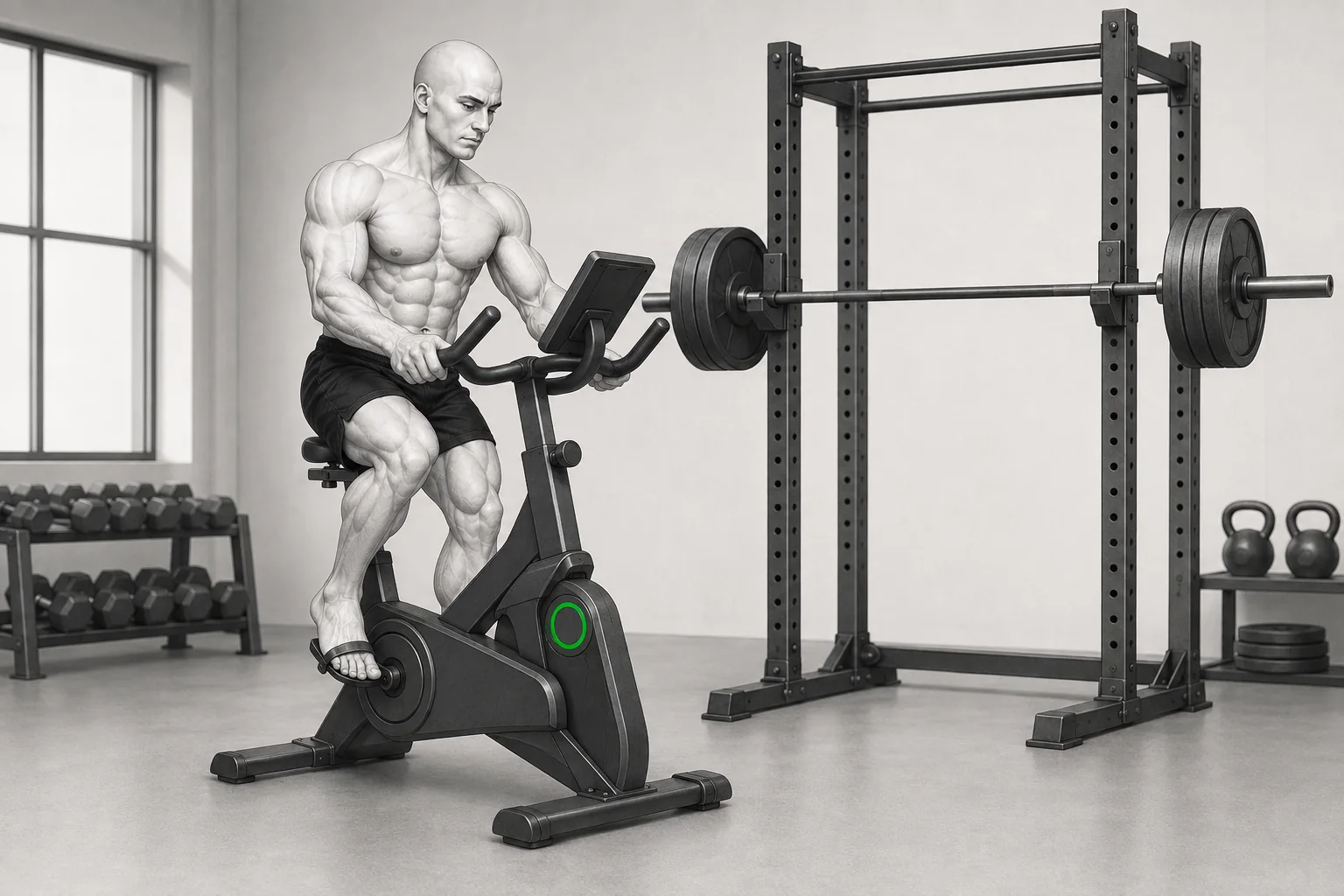
When Can Cardio Interfere With Progress?
The main risk is not sudden muscle loss but interference: cardio leaves enough fatigue to reduce the quality of your strength work or slow a very specific adaptation. Two situations deserve particular attention:
- a demanding cardio session tires your legs immediately before squats or deadlifts;
- your total weekly training load rises faster than your ability to recover.
In the 43-study meta-analysis, explosive strength improved less with concurrent training, especially when both activities were performed in the same session. Another meta-analysis of 27 studies found a small negative effect on lower-body maximal strength in trained lifters, but not in beginners or moderately trained people. Among trained lifters, the effect appeared when both activities were in the same session, not when they were separated by more than two hours.
What depends on you: your level, cardio difficulty, the muscles involved, sleep, nutrition, and the margin left in your sets. One weaker workout does not prove interference; a repeated trend across comparable workouts deserves an adjustment.
How Much Cardio Should You Add While Strength Training?
There is no universal number of minutes that protects every goal. If you are a beginner who has done little cardio, start with two easy-to-moderate sessions of 20–30 minutes per week. That equals 2 × 20 = 40 to 2 × 30 = 60 minutes per week. It is a practical starting point, not a scientific threshold or a final health target.
At moderate intensity, you can speak in short sentences and finish without draining the energy you need for your next lifting session. Then increase only one variable at a time: add five to ten minutes to one session or add one easy session. Keep the new level long enough to assess recovery.
For general health, the WHO recommends 150–300 minutes of moderate aerobic activity per week for adults, or 75–150 minutes of vigorous activity, plus muscle-strengthening activity on at least two days per week. This population-level target does not say exactly how to schedule cardio around your program. Build toward it gradually when it fits your situation instead of adding it all at once.
| What you observe | Practical decision | What you keep stable |
|---|---|---|
| Priority sets are progressing | Keep the cardio | Duration, intensity, and timing |
| One lifting session is weaker | Do not conclude anything yet | Program and cardio |
| Leg exercises decline repeatedly | Move leg-focused cardio away or make it easier | Exercises, RIR, and rest times |
| Fatigue affects the whole program | Reduce the hardest cardio session first | Priority strength sets |
Should You Do Cardio Before or After Strength Training?
If strength training is the priority and you must do everything in one workout, lift first. This lets you approach the movements where load, technique, and progress matter most while fresh. A systematic review and meta-analysis of ten studies favored strength followed by endurance training for developing dynamic lower-body strength. It found no clear effect of exercise order on hypertrophy, static strength, or aerobic capacity.
| Priority | Suggested timing | Why |
|---|---|---|
| Muscle gain or strength | Strength training, then cardio | Preserve the quality of working sets |
| Explosive strength or advanced performance | Separate sessions by at least three hours when possible | Limit the observed interference with explosive strength |
| General health with limited time | Same session is acceptable | Consistency matters more than a perfect schedule |
| Endurance performance is the priority | Cardio first or a separate session | Be fresh for the priority quality |
The three-hour interval comes from a subgroup analysis of explosive strength; it is not a magic boundary. If you can use two different days, scheduling becomes even simpler. The guide to three- to five-day workout programs helps you place priorities without stacking every demand on the same day.
What Type of Cardio Should You Choose With Strength Training?
The main meta-analysis found no significant difference between running and cycling for hypertrophy or maximal strength. That does not prove every mode creates the same fatigue for every trainee. Choose the one you can dose, repeat, and recover from without changing your lifting technique.
- the stationary bike makes it easy to adjust intensity and maintain a steady pace;
- running works if you enjoy it and the impact does not disrupt your leg workouts;
- the rowing machine also involves the back and arms, so avoid a hard session immediately before a pulling workout;
- the stair climber loads the quadriceps and glutes heavily, which matters when scheduling it around squats.
These choices are practical guidelines. The theoretically “ideal” mode is a poor choice if it repeatedly makes you cancel lifting, shorten your range of motion, or miss planned reps.
How Can You Check Whether Cardio Is Slowing Your Results?
- Keep the same strength exercises, rep range, and a comparable RIR.
- Keep the cardio days, duration, and approximate intensity fixed for three weeks.
- In your ShapeVision workout log, compare the loads and reps in your priority sets.
- Always use the same formula when tracking e1RM.
- Change the cardio only if the decline repeats across several comparable workouts.
Recalculated example: 80 kg × 8 reps gives an e1RM of 101.3 kg with the Epley formula: 80 × (1 + 8 ÷ 30). After adding cardio, 80 kg × 8 at the same RIR shows no decline. A single workout at 80 kg × 6 gives an estimated 96 kg, but that is not enough to draw a conclusion. Use the e1RM calculator with the same formula and follow the method in the guide to measure real progress.
If several leg exercises decline together, first move cardio away from the priority workout or reduce its difficulty. If performance declines across the board alongside general fatigue, also examine sleep, energy intake, and total volume; the guide to a deload week helps distinguish a scheduling problem from a broader need for recovery. To support training, also check your daily protein intake without blaming every fluctuation on cardio.
Sources and methodology
These sources show that a combined program can preserve hypertrophy and maximal strength on average. The main limitations are the range of protocols, the short duration of many studies, and more sensitive outcomes such as explosive strength or lower-body strength in trained lifters.
Frequently asked questions
Does Cardio Make You Lose Muscle?
No, not automatically. Pooled evidence shows no average reduction in hypertrophy or maximal strength when cardio and strength training are combined. The amount, timing, and your recovery still matter.
How Much Cardio Can You Do Without Interfering With Strength Training?
If you are a beginner, test two easy-to-moderate 20–30-minute sessions per week, then increase gradually if your priority sets and recovery remain stable. This is a practical starting point, not a universal limit.
Is It Better to Do Cardio Before or After Weights?
If strength or muscle gain is the priority, lift before cardio in a combined session. If endurance is the priority, reverse the order or separate the sessions.
How Long Should You Separate Cardio and Strength Training?
When explosive strength is the priority or you are an advanced trainee, separating sessions by at least three hours is a reasonable guideline. A beginner can focus on the schedule they can follow consistently.
Is Cycling Better Than Running Alongside Strength Training?
Neither mode has shown a clear overall advantage for hypertrophy or maximal strength. Choose the mode you recover from best and schedule it according to the muscles involved.