
Stance width and toe angle are two different settings
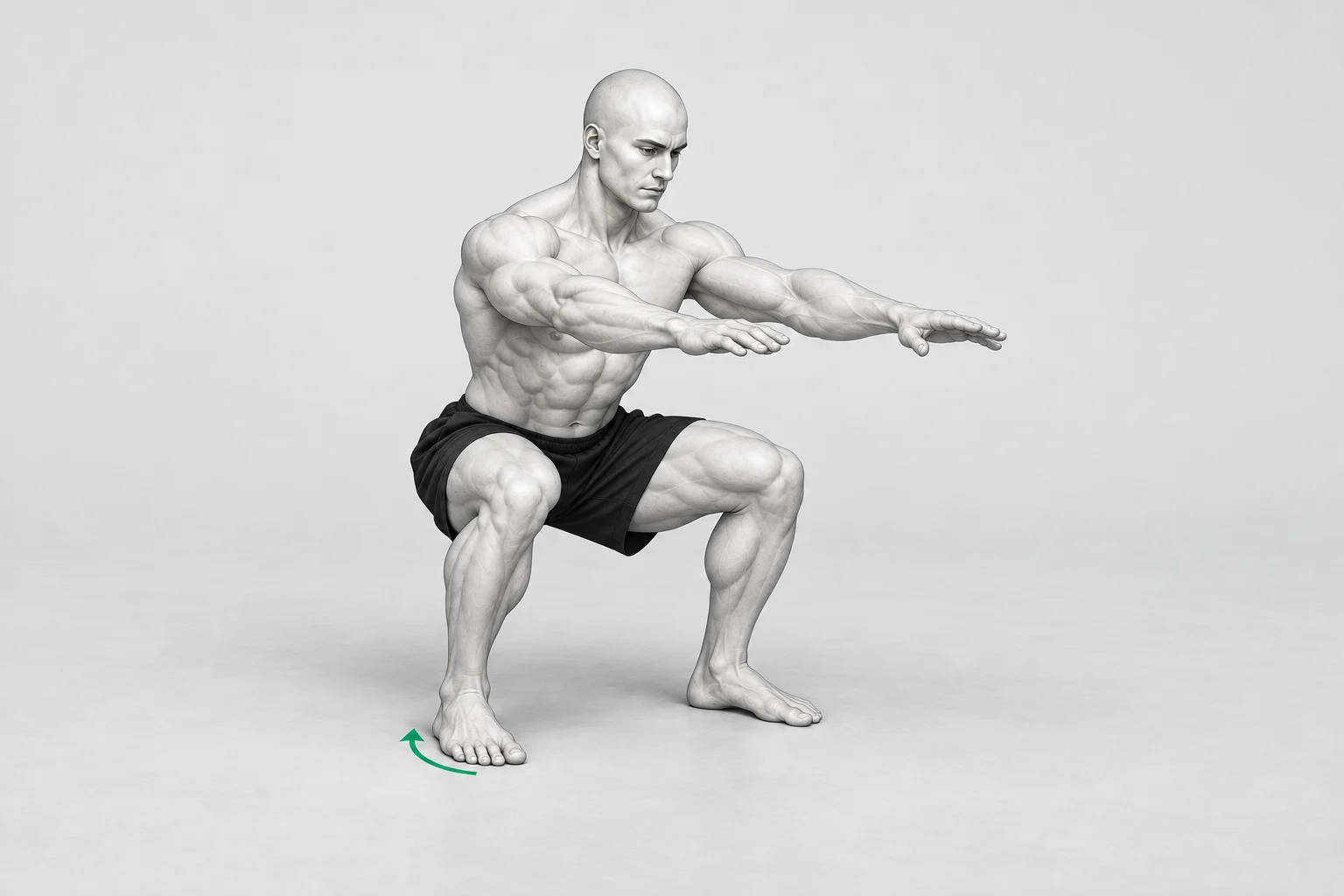
Stance width is the distance between your feet. Toe angle describes how far they point outward. You can widen your stance without turning your feet further, or turn your toes out slightly without moving your heels. Changing both at once makes it harder to tell what helps.
Shoulder width is simply an easy reference to reproduce. You do not need to measure an exact angle or copy another lifter’s foot position. First look for contact through both heel and forefoot, without clearly rolling onto the inner or outer edge.
What the research can actually tell us
Lorenzetti and colleagues (2018) studied 42 novice or experienced participants using three stance widths and three toe angles. These settings changed movement and joint moments—the turning effects of forces around joints. Only the experienced lifters also used an external load, equal to half their body weight.
This biomechanics study measured neither muscle growth over several months nor injury rates. It shows that changing foot placement changes the movement, not that one exact position is safest or grows the biggest quads. The angles tested are therefore not mandatory instructions.
Do long thighs mean you need a wide squat stance?
Not automatically. In a study by Demers and colleagues (2018) in 32 young adults, widening the stance mainly reduced the ankle dorsiflexion required during unloaded squats. Relatively long thighs compared with the lower legs were associated with more ankle and knee flexion in the narrow and medium stances.
Dorsiflexion brings the shin toward the top of the foot. A slightly wider stance may therefore be worth testing if you struggle to settle into the bottom position. But participants were young, able to squat and tested without load: this does not give us a formula linking femur length to foot spacing. Results at the greatest depths also involved fewer participants.
In practice, do not try to infer the shape of your hip joints from a photo or a single repetition. Your proportions provide context; stability and ease of movement remain the decision criteria.
A simple test during your warm-up
This is a practical method, not a validated protocol for finding a perfect stance. Use body weight or a light bar, stay well away from failure and keep the same shoes.
- Perform a few reps with your usual stance. Notice the depth you control and how your feet contact the floor.
- Move your feet a little wider without seeking an extreme position. Compare at a similar depth, then return to your starting stance if the movement feels less smooth.
- Once you have chosen the width, adjust the toe angle slightly. Let your knees broadly follow their direction; do not push them outward as far as possible.
- Check the setup through your ramp-up sets. Keep it only if you can reproduce the foot contact and movement as the load increases.
To organize that ramp-up, use the guide to warm-up sets. If a position causes unusual pain, stop the test rather than forcing a supposedly ideal angle.
Three mistakes that make comparisons misleading
Squatting less deeply after widening your stance does not prove you have become stronger. Changing shoes, bar position and load at the same time prevents you from isolating the effect of foot placement. And a stronger sensation in one muscle is not enough to predict more growth.
First establish a comparable range of motion and then compare several workouts. Some forward torso lean does not by itself mean that your feet are positioned incorrectly.
Should every squat variation use the same stance?
No. The back squat and front squat place the load differently. On the hack squat machine your foot position also depends on the platform and back pad. Test each variation with a light load rather than copying the previous stance width exactly.
Once you find a suitable setup, keep it long enough to track your sets in your workout log. If depth or stance changes substantially, treat the first workouts as a new baseline rather than a directly comparable personal best.
Sources and methodology
Both original studies were read in full. They describe immediate biomechanical effects, not long-term superiority for muscle growth or a guarantee against injury. The suggested testing method is a practical guideline to individualize.
Frequently asked questions
Must your feet point straight ahead when squatting?
No. A slight outward angle may work well, but the amount depends on the movement you can control. Adjust with a light load without forcing extreme rotation.
Is a wide squat stance always better for glutes?
No. Changing stance width can change joint demands and movement, but that does not prove greater growth. First choose a stable setup, controlled depth and measurable progression.
My heels lift: should I just widen my stance?
It is one adjustment to test, not an automatic solution. Reduce the load, check your controlled depth and change one variable at a time. If no position remains stable, get your technique checked rather than forcing it.
How can I tell whether my new stance is better?
At comparable depth and effort, you should be able to maintain your foot contact and repeat the reps across several workouts. More weight with a shallower squat is not enough to decide.