What Is a Warm-Up Set?
A warm-up set uses the planned exercise, or a very similar variation, with less load than the working sets. Its purpose is to rehearse the path, check the setup, and approach the target resistance gradually without building substantial fatigue.
It does not replace a working set and generally does not count toward the weekly training volume used to drive progress. A light set taken close to failure is no longer just preparation: it can already reduce the reps available afterward.
What the evidence shows: evidence supports raising muscle temperature for some speed-dependent qualities. A systematic review and meta-analysis of 33 studies and 921 participants found an effect on rapid force development and power, but not on maximal force. It does not establish an ideal number of warm-up sets for strength training.
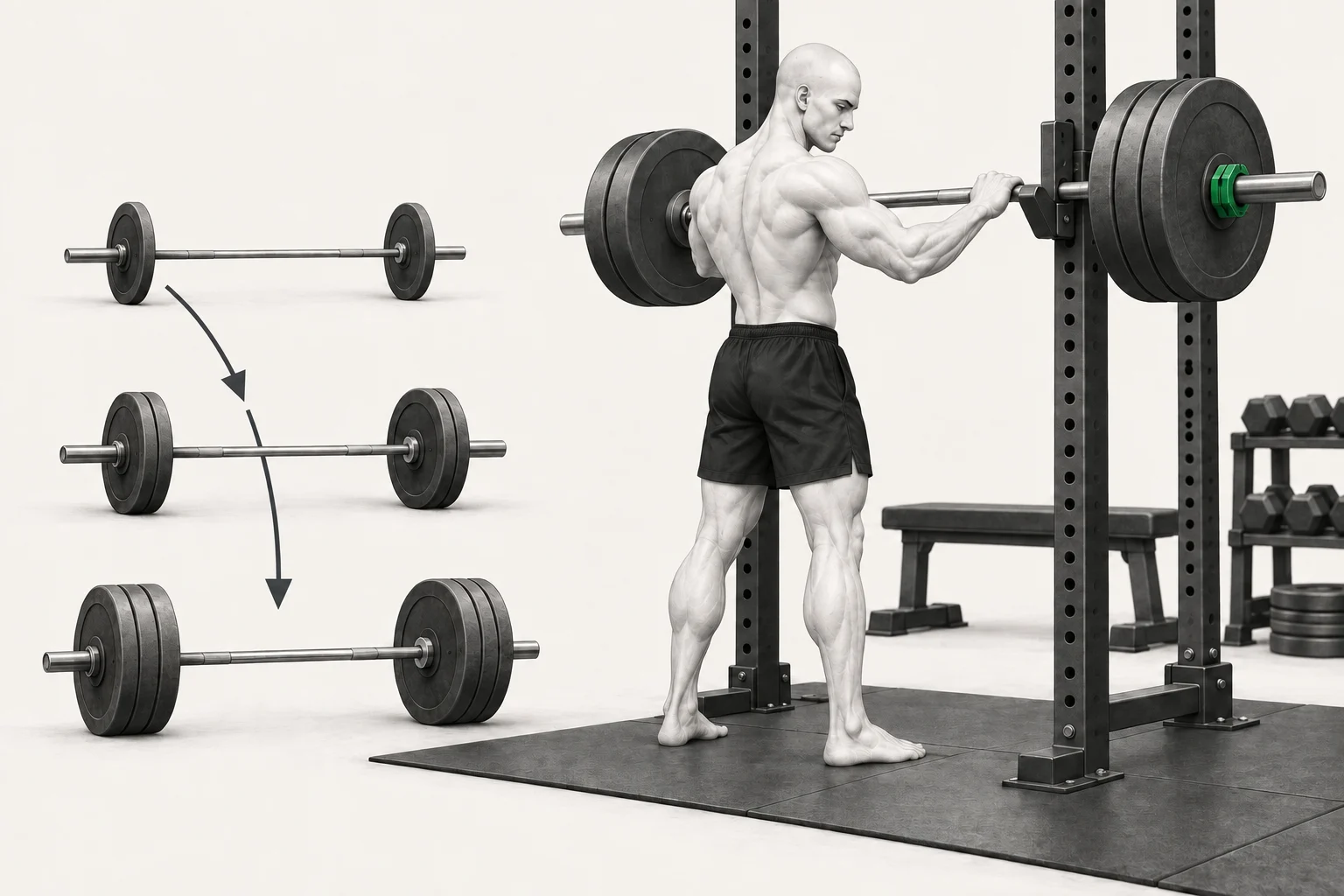
How Many Sets Should You Do for Each Exercise?
The number depends mainly on your first working load, how technical the movement is, what you have already done, and how you feel that day. Use this table as a practical guideline, not a universal evidence-based prescription.
| Situation | Baseline | When to add more |
|---|---|---|
| First heavy squat, press, or pull | 3–5 sets | Heavy working load, body still cold, or technical movement |
| Second compound movement | 1–3 sets | New muscle group, new path, or heavy load |
| Machine after a similar movement | 1–2 sets | Unfamiliar setup or heavy first working set |
| Isolation exercise late in the workout | 0–2 sets | Muscle not yet trained much or unfamiliar movement |
A beginner may need a few extra reps to learn the movement without multiplying heavy sets. An experienced lifter using a heavy load may prefer more steps and very few reps in the final ones.
How Should You Ramp Up the Load?
Start with an easy load, then approach the target set while reducing reps. Calculate percentages from the planned working load, not necessarily from your 1RM.
- First light step: 8–10 easy, controlled reps.
- Intermediate step: 4–6 reps.
- Heavier step: 2–3 reps.
- Optional final step: 1–2 reps close to the target load, still well away from failure.
A crossover study in 40 trained men compared three preparations before 3 sets of 6 reps in the squat or bench press. Two 6-rep sets at 40% and then 80% of the working load improved some mechanical measures in the bench press compared with one light set; in the squat, one set at 80% of the working load performed better than one at 40% in some sets. The study did not test every combination or include women, so it supports a specific, progressive approach rather than a mandatory sequence.
Example Before a 100 kg Squat for 6 Reps
For a first working set of back squat at 100 kg, one possible ramp-up is:
| Step | Load | Reps |
|---|---|---|
| 1 | 20 kg | 8–10 |
| 2 | 50 kg | 5 |
| 3 | 70 kg | 3 |
| 4 | 85 kg | 1–2 |
| Working set | 100 kg | 6 |
Checked calculation: the four steps represent 20%, 50%, 70%, and 85% of the 100 kg working load. They do not predict your 1RM.
If 100 kg is a moderate load for you after several leg exercises, you can remove the first or second step. If you arrive cold, technique feels unstable, or the first set is very heavy, keep more steps. The guide to exercise order explains why the same load does not require the same preparation at the start and in the middle of a workout.
How Do You Avoid Fatigue While Warming Up?
- Do not take any warm-up set to failure.
- Reduce reps as the load approaches the target set.
- Avoid long sets that create a local burn before a heavy effort.
- Rest long enough after the final step to begin the working set with calm breathing.
- Add a step instead of making a load jump that changes your movement path.
Decision criterion: the final warm-up rep should remain crisp. If it slows sharply, degrades technique, or greatly increases perceived effort, the preparation was probably too costly. Use the guide to RIR and muscular failure to distinguish an easy set from one that is already stimulating.
In 57 trained women aged 60 and older, a specific warm-up before four isolation exercises did not improve total reps and even reduced performance in the two upper-body exercises. This result does not apply to every lifter, but it shows that adding work before every isolation exercise is not automatically useful.
Should You Warm Up Again for Every Exercise?
No. If you move from the barbell bench press to the incline dumbbell press, your chest, triceps, and pressing path have already worked, so one or two light sets may be enough to check the new angle. Moving from a press to a squat, however, introduces a new muscle group and coordination pattern, so another ramp-up makes more sense.
A crossover study in 22 recreationally trained men found that re-warming improved some measures of squat velocity and power when squats followed bench presses, but added little to the bench press when it followed squats. The result therefore depends on the exercise and sequence and does not support the same number of sets everywhere.
In your workout log, mainly keep working sets separate from warm-up steps. Record the ramp-up only when it helps you reproduce effective preparation or explain a performance drop. Then compare loads and reps at the same position in the workout using the guide to measuring progress.
Sources and methodology
Direct studies compare different protocols, exercises, and populations. They support specific preparation that limits fatigue but do not establish a universal number of sets. The ranges in this article are therefore practical guidelines to adjust.
Frequently asked questions
Do Warm-Up Sets Count Toward Training Volume?
Not toward working-set volume when they remain easy and well away from failure. Keep them separate in your log so they do not artificially inflate the number of stimulating sets.
Should You Warm Up Before Every Exercise?
Not by the same amount. After a similar movement, zero to two sets may be enough. For a new heavy movement or another muscle group, ramp up again gradually.
What Percentage Should You Use for the Final Warm-Up Set?
In practice, one or two reps at about 80–90% of the working load often make a useful final step. This is not a universal threshold: reduce it if it causes fatigue or degrades technique.
How Many Reps Should You Do While Warming Up?
Do more reps with light loads, then taper gradually: about 8–10, then 4–6, 2–3, and optionally 1–2 before a heavy set.
How Do You Know If Your Warm-Up Is Too Long?
It is probably too costly if you feel a burn, substantial fatigue, persistent breathlessness, or a clear slowdown before the first working set.