What Is the Difference Between Machines and Free Weights?
A free weight is a load you move without an apparatus dictating its path, such as a barbell or dumbbell. You control the load path and stabilize the movement. A machine guides the path or resistance more, such as a leg press or converging chest press.
The distinction is not perfect: a Smith machine fixes the bar path, while a cable allows some freedom. When choosing, look at the exercise's actual constraints rather than its label: path, setup, stability demands, available range of motion, and resistance curve.
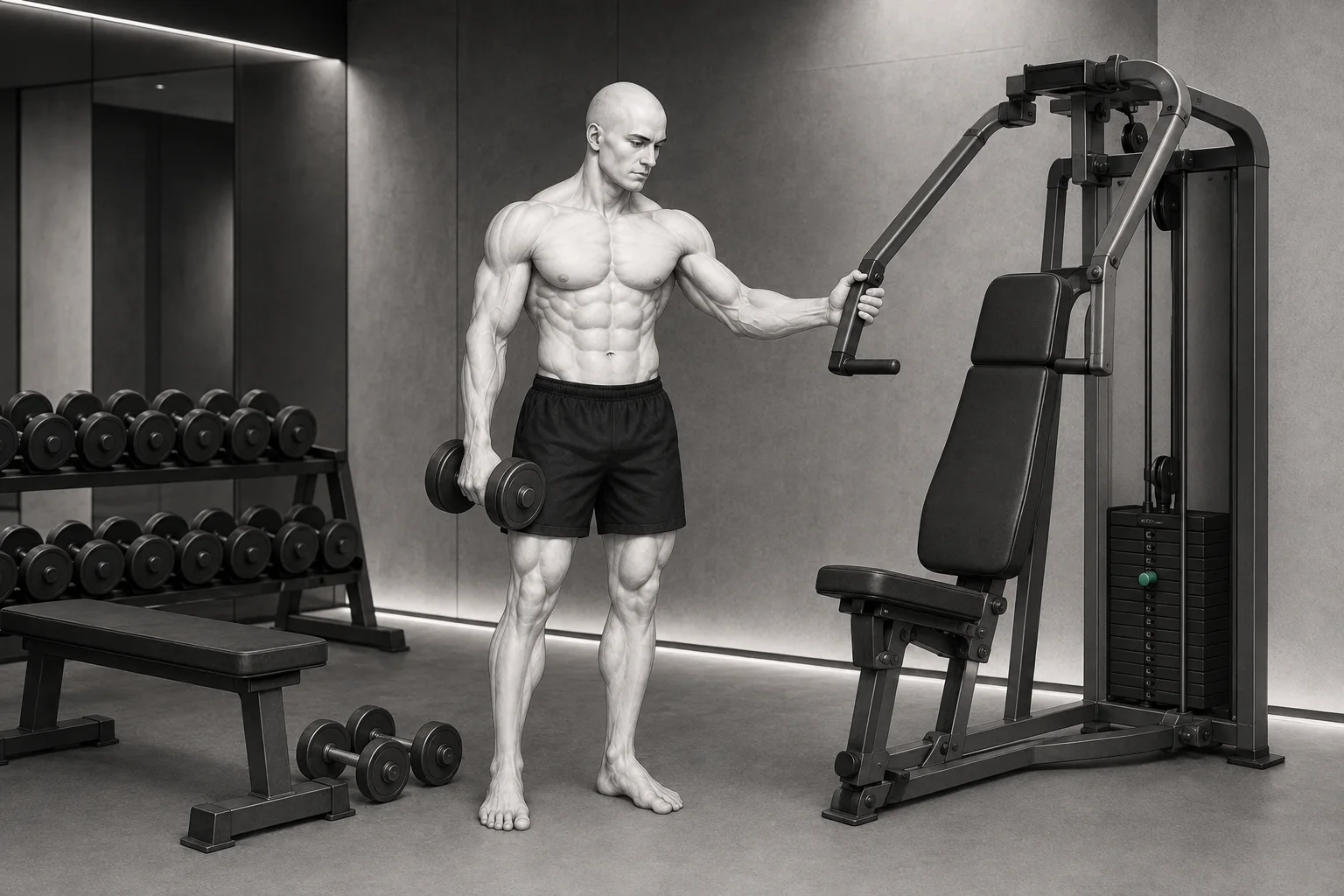
Which Builds More Muscle?
What the evidence shows: neither mode clearly produces greater overall hypertrophy. A systematic review and meta-analysis of 13 studies and 1,016 participants found no significant difference between machines and free weights. However, the hypertrophy analysis included only five studies using varied measurement methods. It rules out an obvious winner, but it does not show that every exercise is interchangeable.
The 2026 American College of Sports Medicine position stand, based on 137 systematic reviews, also concludes that equipment type does not consistently affect training outcomes. The specific exercise you choose may still change which muscles or regions receive the greatest stimulus. Compare variations that serve the same goal, using a controlled range of motion and measurable progression.
Which Builds More Strength?
Strength follows the principle of specificity: you improve most at the task you practice. In the same meta-analysis, free-weight tests favored free-weight training, while machine tests tended to favor machine training. When each group was tested in its own training mode, neither showed an overall advantage.
If you want to improve your barbell squat, train the back squat. If your goal is to lift more on a leg press, train that leg press. Do not directly compare 100 kg on a machine with 100 kg on a barbell: path, leverage, friction, and resistance differ. The guide to measuring progress explains how to compare a variation only with its own history.
How Should You Choose for Your Situation?
| Situation | Starting Choice | How to Validate It |
|---|---|---|
| Strength in a tested lift | The movement and equipment used in the test | The same technique used for the test |
| General Hypertrophy | Machine or free weight | Target muscle is limiting, stable range, and room to progress |
| Need freedom of movement | Barbell or dumbbells | Natural, repeatable path |
| Stability fails before the target muscle | Well-adjusted machine | The target muscle, not balance, ends the set |
| Busy gym or changing equipment | Option that is regularly available | The same variation is available week to week |
Practical guideline: test the setup and a few controlled sets before deciding. The guide to adapting exercises to your body proportions helps you check whether the path, support points, and range of motion suit your proportions. Neither “free” nor “guided” guarantees a good fit by itself.
How Can You Compare Two Variations Without Distorting Your Tracking?
Treat each variation as a separate exercise. For example, keep separate histories for the barbell bench press and converging machine chest press, or for the barbell overhead press and machine shoulder press.
- Set the variation, seat or bench position, and range of motion.
- Choose a rep range and target RIR.
- Keep the exercise in a similar position within the workout.
- Record every set in your log for several weeks.
- Assess the trend in reps, load, and effort without converting kilograms from one variation to another.
Also keep your rep speed consistent. A shorter rep or one performed with more momentum is not directly comparable.
Should You Combine Machines and Free Weights?
You can combine them, but you do not have to. The meta-analysis suggests that a mix might cover a wider range of adaptations, while explicitly noting that this is a hypothesis rather than a proven advantage. A machines-only or free-weights-only program can therefore work if it covers your movement needs, progresses, and fits your constraints.
Practical guideline: keep one main variation for each movement for four to six weeks before judging it. This is not a universal scientific threshold; it is a practical way to collect enough comparable workouts. Replace a variation if the setup does not suit you, the equipment is not regularly available, or another option better matches your goal. Do not switch simply because a machine displays more kilograms.
Both options are valid for beginners. In a ten-week randomized trial in 36 novice men, machines, free weights, and switching from machines to free weights all produced improvements with no significant differences between groups. Muscle-size estimates were based on circumferences and the sample included only men, so the result supports flexibility in the initial choice without establishing a universal rule.
Sources and methodology
These sources indicate that machines and free weights can both build muscle and strength. Strength remains specific to the movement practiced, while the hypertrophy evidence is still too limited to name a universal winner.
Frequently asked questions
Are Machines Less Effective for Building Muscle?
No. Available comparisons show no significant overall difference from free weights. Exercise quality, progression, and consistency matter more than the equipment label.
Should a Beginner Start Only on Machines?
No. Both options can work. Choose exercises you can learn, set up, and repeat with control, then add complexity only when it serves your goal.
Are Free Weights More Functional?
They often require more path control and stabilization, but transfer depends on the target task. To become strong at a specific movement, practice that movement or a close match.
Are Machines Always Safer?
No. The evidence does not establish an overall advantage for injury risk. Machine design, setup, load, technique, and training context all matter.
Can You Compare a Machine Load with a Barbell Load?
No. Leverage, path, friction, and sometimes the pulley system change the actual resistance. Compare each exercise only with your previous performance on the same equipment.