
What is the difference between sumo and conventional?
For the conventional deadlift, your feet are closer together and your hands grip the bar outside your legs. In the sumo deadlift, your feet are farther apart and your hands grip the bar between your legs. These setups change the starting geometry and the relative contribution of the joints; they do not identify a winning body type.
To decide, first check whether you can position yourself over the bar, keep a secure grip and start without the bar drifting away. A setup that looks suitable in a photo is not necessarily one you can repeat comfortably.
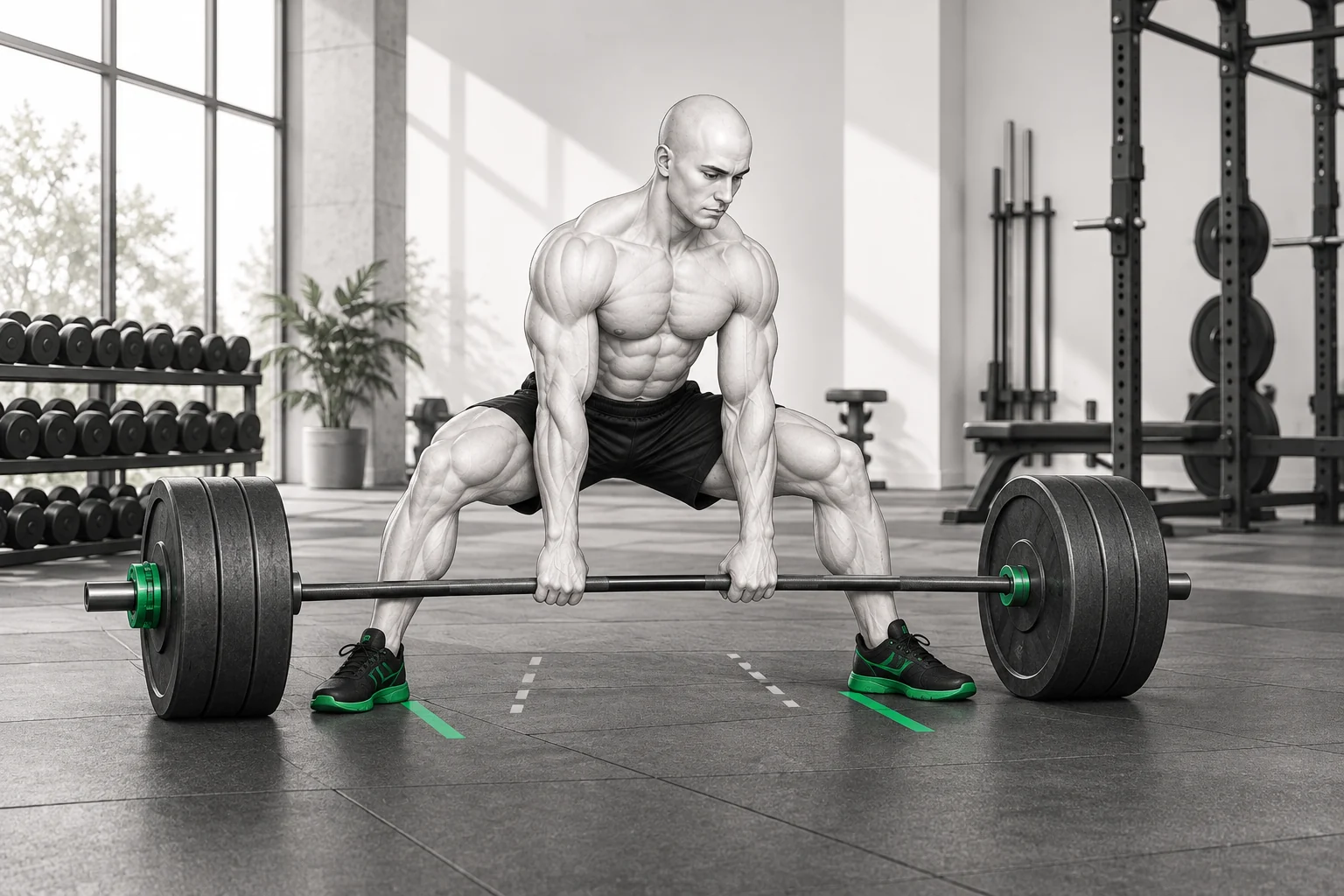
What does research actually say about body proportions?
Cholewa and colleagues taught both variations to 47 people with no prior deadlift experience. Their analysis found an association between relative seated height and maximal sumo performance compared with conventional. Participants had relatively long arms with little variation, so the findings cannot establish a general rule based on arm length.
In a preliminary study of 11 trained men, Derav and colleagues examined body measurements and conventional-deadlift kinematics. Most associations with arm, torso or leg-segment lengths were not significant. The small sample and the study of conventional style alone limit the conclusions.
A study of 30 trained men, published by Hanen and colleagues, found immediate differences in joint angles and moments between the two styles under a heavy load. It describes biomechanics during the tested task; it does not demonstrate a lasting hypertrophy advantage or a body-proportion rule.
In practice, use your proportions as a clue for deciding what to test. Your individual results, technique and repeatability matter more than a formula based on a single body measurement.
How should you test both setups?
- Start with a light load. Perform a few reps with each variation without attempting a personal best.
- Check your setup. Keep the bar close to your legs and choose a foot position that lets you push the floor without losing balance.
- Compare one thing at a time. Note your stability at the start, bar path, range of motion and comfort. Do not change your shoes, load and stance width all at once.
- Repeat across several workouts. Compare sets with similar effort and rep counts before choosing a variation.
If your grip gives out before your legs and back receive the intended work, lifting straps may be an accessory to consider separately. They do not replace a repeatable starting position.
Which variation should you keep in your program?
Keep the variation where you can reset consistently for every rep and manage the load without an abrupt change in technique. If both feel comfortable, use one as your main lift for several weeks and track sets, reps and loads. Keep the other as an accessory if it fits your program.
To tell whether a change actually helps, compare similar workouts rather than one isolated max rep. The guide to tracking your progress and the guide to keeping a training log offer guidance for tracking that progress.
If you are adapting a program to your proportions, the guide to exercise selection for your build helps you compare movements without assuming that one measurement determines your entire technique.
How can you track your choice over time?
In your log, record the style you used along with sets, reps and loads. Keep effort similar and note any substantial setup changes. Comparisons become more useful when workouts are alike enough to separate progress from a change in variation.
ShapeVision is first a strength-training log for recording your sets and tracking progress. Morphology analysis and personalized program generation complement that log, while your own workouts show whether sumo or conventional works better for you.
Sources and methodology
The studies below examine small groups and specific tasks. They describe biomechanical differences and associations, but do not show that one variation builds more muscle or suits everyone with similar proportions. The comparison steps are practical guidelines.
Frequently asked questions
Do long arms automatically favor the conventional deadlift?
No. Arm length can change how far the bar travels, but it cannot by itself predict which setup will work best for an individual. Technique, torso and leg proportions, comfort and familiarity also matter.
Is sumo always easier if you have a long torso?
No. One study of novice lifters found an association between relative seated height and sumo performance compared with conventional, but that result is not an individual selection rule. Test your own setup and technique.
How can you compare both variations without testing a max?
Use a light or moderate load and perform a few clean reps with each setup. Compare your starting stability, bar closeness, bar path and ability to repeat the reps. Repeat the comparison across several workouts before concluding that one works better.