
First decide what the number represents
The weight of one object, the combined weight of several objects and a machine’s label are different reference points. No log can make comparisons reliable if you switch between them without preserving that distinction. The following is a practical convention, not a universal standard imposed on every app.
| Equipment | Weight to record | Example reference |
|---|---|---|
| Free barbell | Bar + all plates | 60 kg total |
| Two matching dumbbells | Weight per dumbbell, if using this convention | 20 kg per dumbbell |
| Weight-stack machine | Displayed setting, on the same machine | Setting 40 on this machine |
If you are unsure which other details to keep, the guide to what to record in your workout log explains sets, reps, equipment settings and effort. Here, we focus specifically on the weight figure.
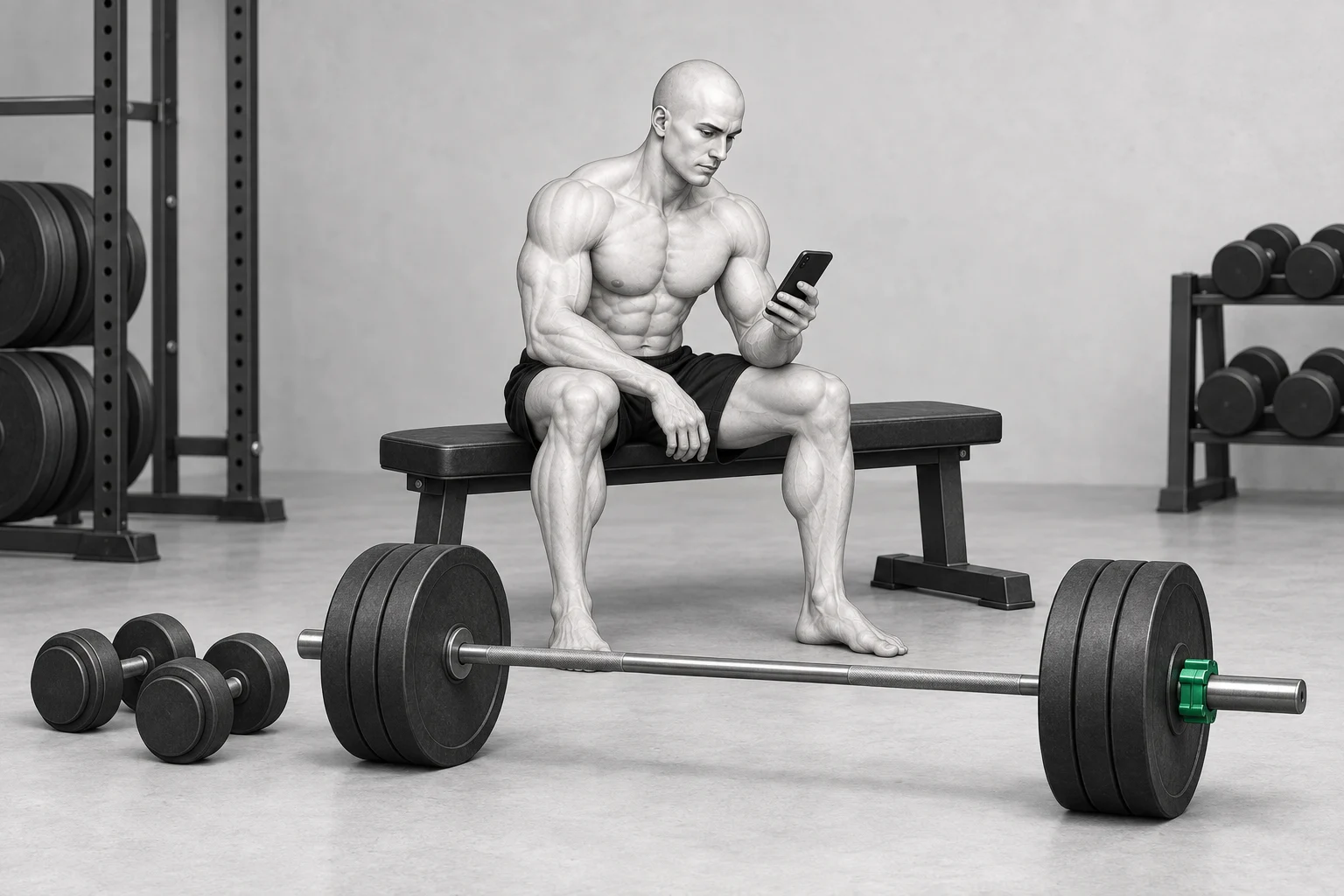
Should you include the weight of the bar?
Yes, for a free barbell: you are also moving the bar. With a verified 20 kg bar and one 20 kg plate on each side, the total is 20 + 20 + 20 = 60 kg. It is neither just 40 kg of plates nor 40 kg per side.
Do not assume every bar weighs 20 kg. The official Eleiko guide describes 20 kg and 15 kg models, as well as a 10 kg technique bar. Check the model or ask gym staff; these examples do not let you identify a bar’s weight by sight.
Also include the collars if their weight is known and part of your total. If you do not count lightweight clips, keep that convention explicit and use the same equipment. To add 2.5 kg in total, place 1.25 kg on each side: 60 + 2 × 1.25 = 62.5 kg. The increase is not 1.25 kg.
This applies, for example, to the free-barbell bench press. A Smith machine is not a free barbell: use the starting resistance specified by its manufacturer, rather than automatically assigning 20 kg.
With dumbbells, should you log one weight or the pair?
For the dumbbell bench press, an entry of “20 kg per dumbbell” describes two 20 kg dumbbells. The pair weighs 40 kg, but entering 40 in a history previously logged per dumbbell would artificially double the weight.
If your log explicitly asks for the total weight, follow that instruction. Otherwise, choose a clear convention and stick to it. Ten simultaneous reps with two dumbbells are still ten reps of the movement, not twenty. For alternating exercises, separately clarify whether reps are counted per side or in total.
With an adjustable dumbbell, read the instructions: a displayed weight may already include the handle. Do not add that mass twice. If you assemble the handle, plates and collars yourself, add up the parts actually present on one dumbbell.
Why two machines displaying 40 are not equivalent
The manufacturer Life Fitness specifies a 4:1 resistance ratio for one dual adjustable pulley model. This is a feature of that model, not all cable machines. A stack number therefore cannot automatically be treated as an equivalent free weight.
For your log, the simplest approach is to keep the displayed value, its unit when given and the identity of the machine. If the scale only shows a plate number, do not call it an exact weight in kilograms. Do not divide a label by two or four without knowing what it already represents.
For the close-grip cable row, use the same station and settings when comparing workouts. If you change machines, establish a new reference point and find an appropriate working weight. Moving from 40 on one machine to 35 on another does not prove a loss of strength.
How do you handle a history logged with another convention?
Do not turn a recording change into a personal best. If you counted only the plates on a known 20 kg bar, your old 40 kg entries actually represented 60 kg including the bar. On the day you start logging 60, the resistance has not increased.
Keep a separate record of the date of the change and your previous convention. Recalculate earlier workouts only if you know exactly which equipment and rule you used. If you no longer know, preserve that uncertainty and start a new comparison from the reliable convention.
The convention alone is not enough: the guide to measuring progress also explains how to keep technique and effort comparable. Correct arithmetic does not make two different exercises equivalent.
Sources and methodology
The official manufacturer documents were read in full to verify bar weights and the existence of a model-specific pulley ratio. They do not show that one logging convention builds more muscle. The suggested conventions are practical; no equipment purchase is recommended.
Frequently asked questions
Does an empty bar count as 0 kg?
Not for a free barbell. Log its actual weight, checked against the model or with gym staff. A bar without plates is not zero weight.
Should two 20 kg dumbbells be logged as 20 or 40 kg?
20 if you log weight per dumbbell; 40 if your log asks for the pair’s total. Follow the field label and do not switch conventions midway through your history without noting it.
Should you convert every cable machine to actual kilograms?
No. For tracking workouts, mainly keep the displayed value and the same machine. Without precise documentation of the model and its labels, a conversion may create false precision.
Can you compare the total of two dumbbells with a barbell?
Not as an equivalent performance. Even if the masses add up, the equipment and exercise differ. Compare each variation with its own history.