
What does post-workout muscle soreness mean?
Muscle soreness is discomfort or stiffness that often follows unfamiliar exercise, especially when it includes contractions while the muscle lengthens. It usually develops in the hours after training, is often most noticeable 24 to 72 hours later, then fades. Its intensity does not directly measure workout quality or how much muscle you built.
To assess a workout, also look at what you could actually do and how you perform the movement next time. The guide to measuring progress in strength training explains how to compare workouts under similar conditions.
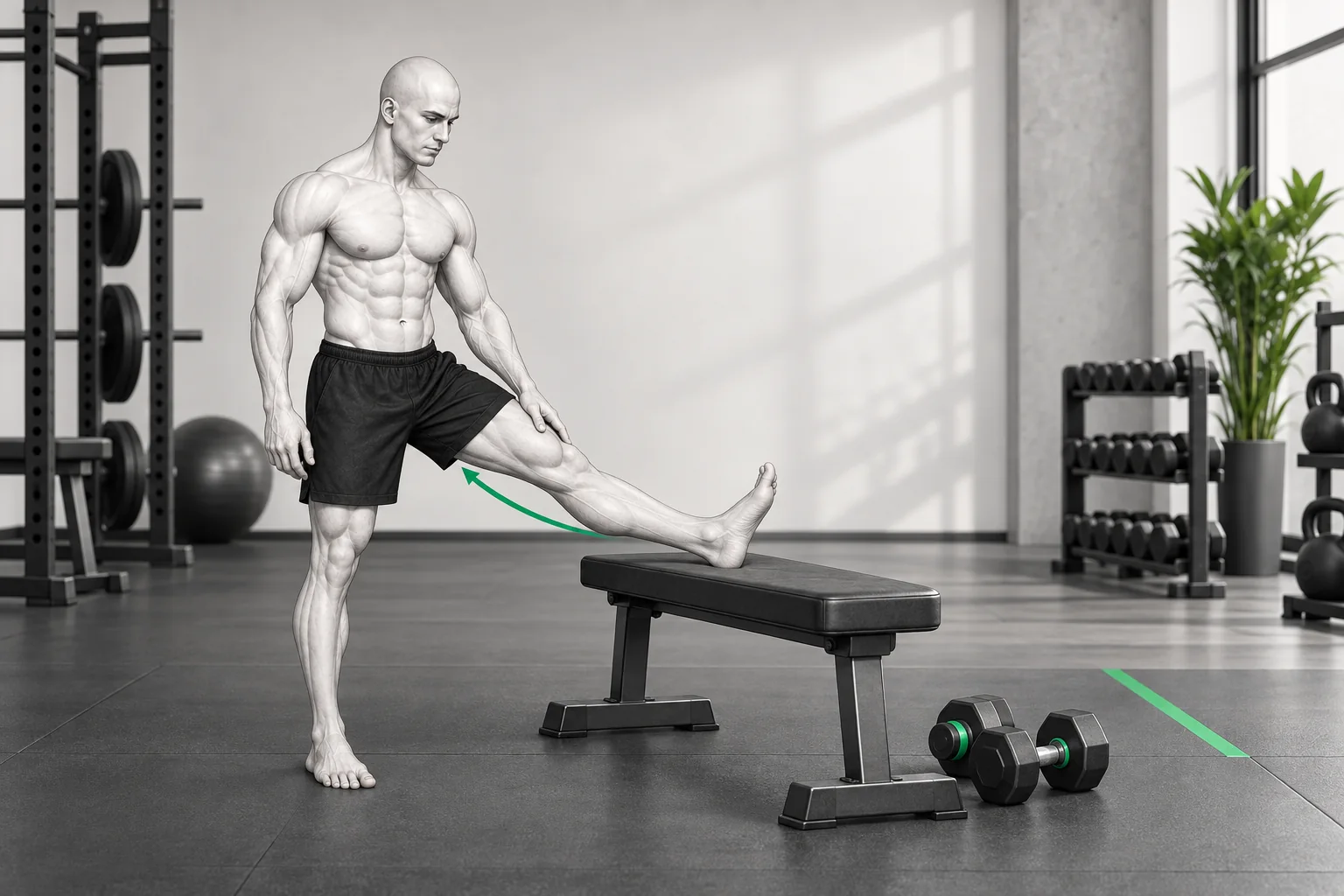
What do studies say about stretching after exercise?
A 2021 systematic review and meta-analysis combined eleven randomized trials involving 229 people aged 17 to 38, mostly men. Sports, exercises and stretching methods varied; only some protocols directly involved strength training. Compared with passive rest, the analysis found no improvement in strength recovery or reduction in soreness at 24, 48 or 72 hours. About 70% of the trials had a high risk of bias, and the authors rated confidence in the overall evidence as very low.
A 2025 umbrella review examined 29 systematic reviews covering 863 unique randomized trials and 24 treatments for soreness. It rated the evidence for stretching as weak. Most included reviews had methodological limitations, so the findings do not establish any recovery technique as a certain solution.
When should you keep post-workout stretching?
| Your reason | Practical choice |
|---|---|
| You enjoy a calm transition | Keep a few comfortable movements if they help you wind down. Do not count them as a proven way to prevent soreness. |
| You want to work on flexibility | Plan the work for that goal and assess flexibility separately from strength-training recovery. |
| You stretch only to avoid soreness | You can skip the routine: trials have not shown that it meaningfully reduces soreness or speeds strength recovery. |
This table turns the limits of the research into a workout decision; it does not compare every mobility method or stretching duration. If you choose to stretch, keep it comfortable and do not force a position in an attempt to speed recovery.
How can you track recovery before your next workout?
Do not make a lack of soreness your workout goal. In your next session, compare the exercise, sets, reps and weight with a similar workout. If performance is similar and you can perform the planned movements with control, mild soreness alone does not show that recovery is poor. If you trained the same muscle recently, the guide to
training frequency per muscle helps you plan workouts; the guide to rest between sets covers recovery during a workout. Record your performance in ShapeVision to see what changes from week to week.If you need to space out closely scheduled workouts, also see how to organize strength training on consecutive days.
Sources and methodology
The reviews cover healthy adults and combine different exercises and protocols, often with small samples. They do not prove that post-workout stretching has no use; they simply do not show a reliable reduction in soreness or faster strength recovery. Possible flexibility benefits are a different question.
Frequently asked questions
Should you stretch after every strength workout?
No. It is not required for recovery. Keep stretching if you enjoy it or are working on flexibility, but it is not necessary to prevent soreness.
Can static stretching make muscle soreness go away?
Available trials and reviews have not found a reliable, meaningful reduction in soreness after a workout. A brief feeling of relief does not necessarily mean the muscles are recovering faster.
Does stretching speed strength recovery?
A meta-analysis of small trials found no difference in strength recovery between post-exercise stretching and passive rest. The authors also noted that data are scarce and confidence in the evidence is very low.
Can you stretch to improve flexibility?
Yes, if that is your goal. This article looks at recovery after training, not flexibility gains. Choose the method and timing for that goal without expecting stretching to remove soreness.