How Much Creatine Should You Take Each Day?
Practical guideline: take 3–5 g of creatine monohydrate per day, at any time, including on rest days. An International Society of Sports Nutrition position stand states that after saturation, 3–5 g per day is generally enough to maintain elevated muscle stores.
This range is not an individual promise. Baseline diet, muscle mass, initial muscle creatine stores, and consistency all influence the response. There is no need to change the dose depending on whether a workout has three or six exercises: creatine works by gradually increasing available stores, not as an instant stimulant.
Do You Need a Creatine Loading Phase?
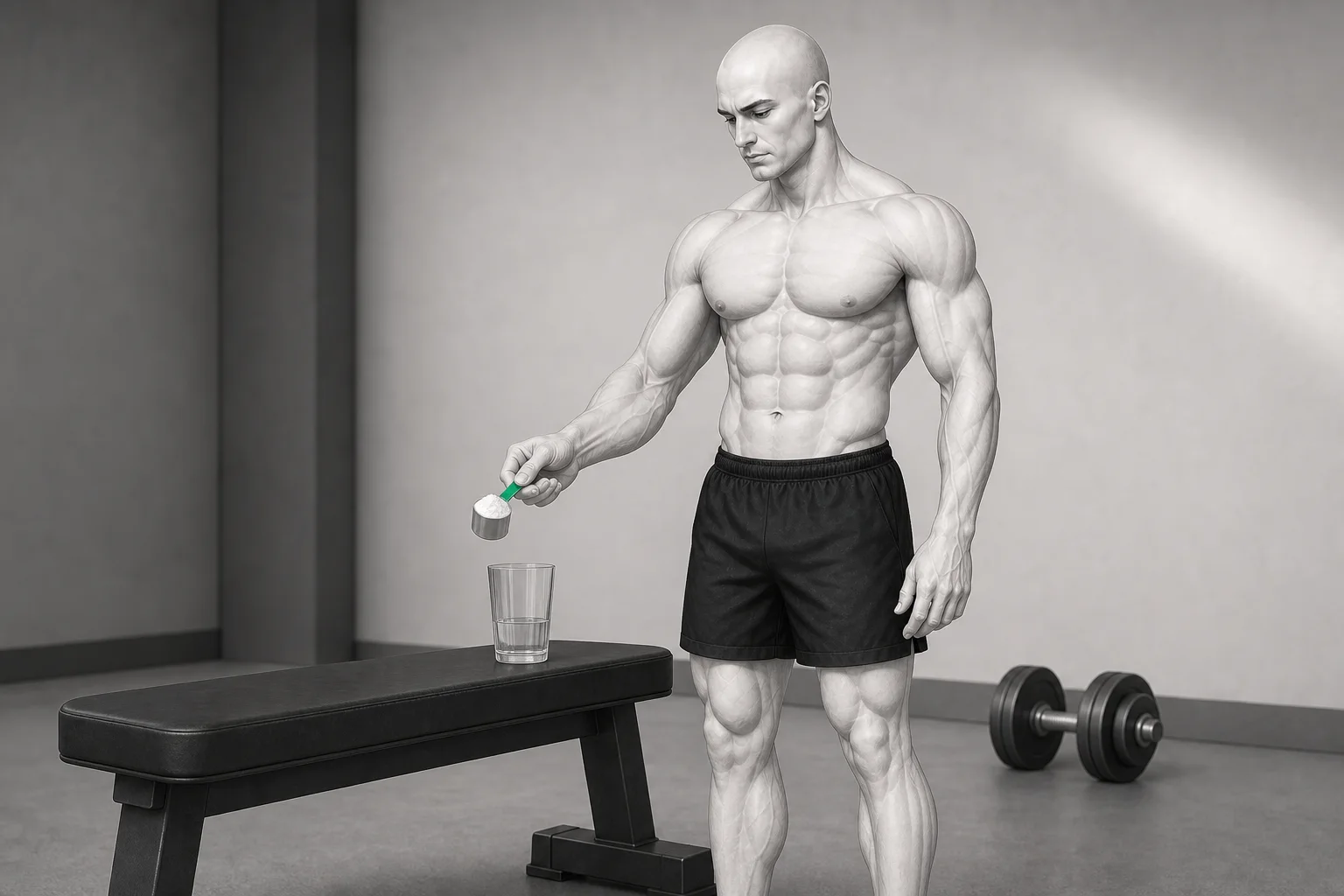
No. A review addressing common questions about creatine concludes that a loading phase is not necessary. Taking 3–5 g per day gradually reaches a similar level of saturation in about four weeks. Loading only gets you there faster.
| Option | Protocol | What it changes |
|---|---|---|
| No loading | 3–5 g per day | Gradual saturation in about 3–4 weeks |
| Rapid loading | About 0.3 g/kg/day for 5–7 days, split into 4 servings, then 3–5 g/day | Faster saturation, with no proven advantage in the final outcome |
Recalculated example for 70 kg: 70 × 0.3 = 21 g per day; 21 ÷ 4 = 5.25 g per serving. Four 5 g servings are a practical approximation. Splitting the dose also avoids one large serving, which may be less well tolerated.
Which Form of Creatine Should You Choose?
Choose plain creatine monohydrate. It is the most extensively studied form. The review of the available literature does not show that more expensive forms increase muscle stores, strength, or performance more effectively.
Check the amount of creatine monohydrate per serving rather than marketing claims. A scoop does not have a universal weight: use the measure stated on the product or a suitable scale. If one serving causes digestive discomfort, split it into smaller portions instead of increasing or doubling the next dose.
An unflavoured creatine monohydrate powder is enough: this option meets the useful criterion without adding a pre-workout blend.
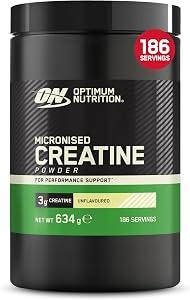 Optimum Nutrition — creatine monohydrateAffiliate link · View on Amazon ↗
When Should You Take Creatine: Before or After Training?
Take it at a time you can repeat every day. A review of creatine timing finds the evidence too limited and conflicting to establish a clear advantage before or after training.
Practical guideline: tie the dose to a stable habit, such as a meal. Keep the same dose on rest days. If you miss a serving, simply resume your usual dose the next day; there is no need to double it. The key factor is consistent accumulation in muscle, not a narrow window around training.
What Results Can You Expect Alongside Strength Training?
Creatine replaces neither a sound program nor progressive overload. It can, however, improve the response to training. A systematic review and meta-analysis of 23 studies in adults under 50 found greater strength gains when creatine was combined with resistance training. Women were underrepresented, so the size of the benefit should not be presented as identical for everyone.
The first change on the scale may include more body water, especially at the start of a loading phase. This is not a direct measure of muscle gained. To assess a useful effect, compare load, reps, and effort on the same exercises across several weeks using the guide on how to measure strength-training progress.
What Precautions Should You Take?
At standard doses, the available evidence is reassuring in healthy adults. A systematic review and meta-analysis of kidney function found a small rise in serum creatinine but no significant decrease in glomerular filtration rate. Creatinine can therefore become harder to interpret without automatically indicating kidney damage.
Tell your clinician about creatine use before a blood test. If you have known kidney disease, take medication, are pregnant, or are breastfeeding, ask a healthcare professional before using it. This guide addresses a general sports-practice question and does not replace individual medical advice.
Finally, assess the supplement in context: first cover your daily needs with the guide to daily protein intake, then keep a workout log that is precise enough to show whether performance is actually changing.
Sources and methodology
These sources distinguish the saturation protocol, the average effect alongside resistance training, uncertainty around timing, and safety data in healthy adults. These reference points do not predict one person’s response.
Frequently asked questions
Should You Take Creatine on Rest Days?
Yes. Take the same daily dose of 3–5 g: the goal is to maintain muscle stores, not create an immediate effect during the workout.
Is a Loading Phase Required?
No. It speeds up saturation, but 3–5 g per day without loading gradually reaches a similar level in about four weeks.
Which Creatine Should You Buy?
Plain creatine monohydrate is enough. Other forms have not shown a consistent advantage for muscle stores, strength, or performance.
Should You Take Creatine Before or After Training?
No clear advantage has been established for either option. Choose the time that is easiest to repeat every day.
Does Creatine Cause Weight Gain?
It can quickly increase body weight by increasing body water, especially during a loading phase. That change alone is not evidence of muscle gain.