
Fixed loads, back-off sets and drop sets: what is the difference?
Fixed load: you use the same weight for all working sets of an exercise. Reps can decrease without the workout being a failure.
Back-off set: you reduce the weight after a heavier set, then perform another set after your planned rest. The reduction can be programmed or based on performance.
Drop set: you reduce the weight and continue almost immediately, without a normal rest interval. This guide covers sets separated by rest, not that intensity technique. Warm-up sets, which prepare you for the work, are a separate category too.
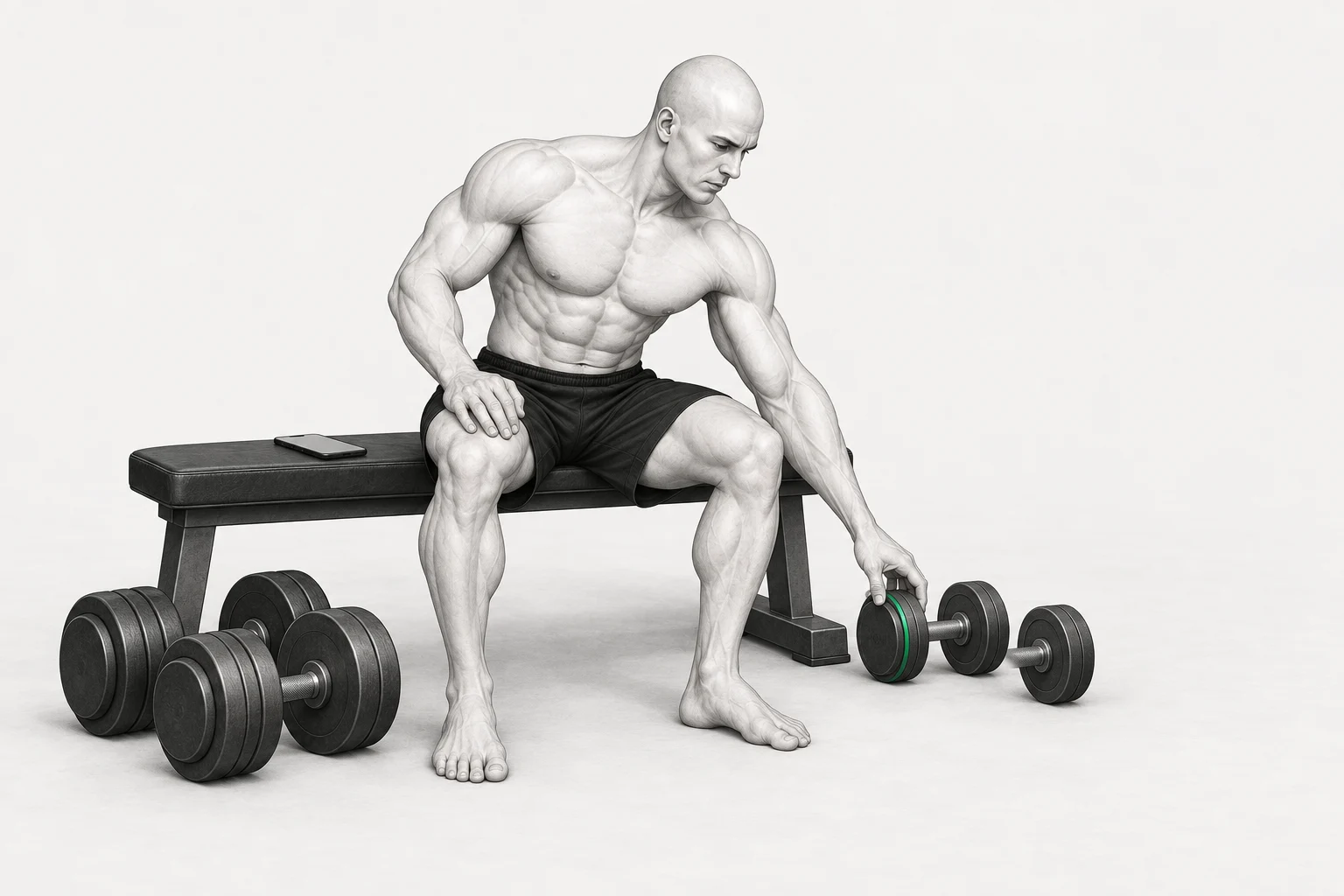
When should you keep the same weight?
Keep the weight if each set meets three criteria: your rep range, planned range of motion and technique, and intended proximity to failure. For three sets of 8–12 reps, for example, completing 12, then 10, then 8 reps can work perfectly well. You do not need to force three identical sets of 12.
This is convenient for tracking: one weight provides a reference, and you can see how reps change at each set position. If a strength program prescribes specific loads, follow its logic first instead of automatically replacing every set with lighter work.
When should you reduce the weight for the next set?
Reduce the weight if you cannot reach the bottom of your rep range without cheating, your range of motion shortens, or you have to reach failure when you intended to leave reps in reserve. These are practical criteria, not universally validated thresholds.
- Set the equipment down and finish your planned rest before deciding.
- If you cut your rest short, address that first.
- If the target is still out of reach, reduce the weight by a small available increment.
- Reassess your reps and technique on the next set.
The guide to rest between sets helps you avoid lowering the weight simply because you start again too soon. For a barbell bench press or a back squat, rerack the bar before changing the plates.
How much should you reduce the weight?
There is no universal percentage. Start with the smallest change that brings you back on target. Going from 60 to 57.5 kg removes 2.5 kg, or about 4.2%. This calculation describes one possible adjustment, not an optimal reduction.
In an acute study of 32 trained women, reducing the weight across three sets helped maintain reps, with the required reduction differing by exercise. However, the sets started at a 10RM load with only one minute of rest. The 5–15% reductions tested are therefore not a rule to apply to every workout.
Your 10RM is the heaviest weight you can lift for ten complete repetitions.
If the jump between dumbbells or machine settings is large, allow reps to vary within the range rather than insisting on the same number at all costs. If even a reasonable reduction no longer allows controlled technique, stop the exercise instead of adding more poor-quality sets.
Example: three sets of 8–12 reps
| Set | Fixed weight | Adjusted weight |
|---|---|---|
| 1 | 60 kg × 12 | 60 kg × 12 |
| 2 | 60 kg × 10 | 57.5 kg × 11 |
| 3 | 60 kg × 8 | 57.5 kg × 10 |
These results are fictional: they illustrate two ways to stay in the range, provided technique and effort match the instructions. The table does not predict your reps or prove that either option leads to more progress. In the adjusted-weight column, the lower weight stays the same for the third set: you do not have to reduce it again every time.
Does reducing the weight between sets limit muscle growth?
Direct evidence is limited. A 16-week trial in 21 trained men compared a fixed load with 5% or 10% reductions between sets of two curl exercises, performed to voluntary exhaustion with one minute of rest. All groups improved; no between-group difference was detected in muscle thickness or 10RM.
This proves neither equivalence across all programs nor the superiority of either method. There were only seven men per group, and the training targeted the elbow flexors. For your barbell curl and preacher curlvariations, prioritize a strategy you can perform and track consistently.
How should you log sets with different weights?
Record one entry per set: actual weight and completed reps. Do not copy the first set’s weight across the entire workout or keep only your best result. Also keep track of rest and estimated reps in reserve in your usual notes to help interpret differences.
Compare the first set with the first, the second with the second, using comparable exercises, order and technique. Going from 60 kg to 57.5 kg during one workout is an adjustment to fatigue; having to reduce the weight more and more across several similar workouts calls for a review of the context.
To organize these details, read what to track in your workout log. To decide when to increase the weight between workouts, then use the progressive overload method. These are two different decisions: adjusting today’s set and progressing future workouts.
Sources and methodology
Two original studies directly addressing load reduction were read in full. Their small trained samples and short rest intervals limit generalization. The decision steps and numerical example are practical guidelines, not validated protocols.
Frequently asked questions
Is it normal to do fewer reps on the second set?
Yes, fatigue can cause this, especially after a very hard first set or a short rest. Keep the weight if you stay within your planned range with controlled technique and the intended effort.
Should you always reduce the weight by 10%?
No. The percentages studied depend on the exercises, rest intervals and protocol. Adjust by a small available increment and check whether the next set is back on target.
Should I reduce the weight even if I complete every set?
No, not if your reps, technique and reps in reserve match the instructions. Reducing the weight is a programming or adjustment option, not a requirement.
Does a lighter set count as a working set?
Yes, if it is part of your planned work and reaches the intended effort with controlled technique. Using less weight does not automatically turn it into a warm-up set.