
Drop sets, traditional sets and supersets are different
With traditional sets, you complete a set, rest and repeat. In a drop set, you finish a hard stage, reduce the weight and continue the same exercise with only the time needed to change loads. You can use one or several reductions.
A superset pairs two exercises. A lighter set after a rest period is still a new traditional set. The key difference is therefore not simply the lighter weight, but the absence of your usual recovery interval.
Do drop sets build more muscle?
A 2026 meta-analysis by Havers and colleagues found no overall advantage for drop sets in hypertrophy or strength. Training studies lasted six to twelve weeks. Perceived exertion was higher in acute comparisons. This supports an effective option, not proof of perfect equivalence for every person.
In an eight-week trial in 27 trained men the methods produced no detected difference in estimated muscle mass. That measurement used bioelectrical impedance rather than local muscle imaging, and not all groups trained to failure. These limitations prevent it from becoming a universal recipe.
The useful question is therefore not “does this burn more?” but “does this format let me perform and track useful work in the time I have?”
When should you choose each method?
- Learning an exercise: keep traditional sets to separate skill practice from accumulated fatigue.
- Protecting a priority heavy lift: keep sets with their planned rest periods.
- Short on time for an accessory you already perform well: a drop set may be worth testing if you can change the load immediately.
- In a crowded gym, or when you must search for several dumbbells: keep traditional sets, since the time saving becomes uncertain.
These are practical guidelines, not scientific thresholds. You can keep your usual main lifts and test a drop set on just one exercise near the end of the workout.
A simple example: one planned weight reduction
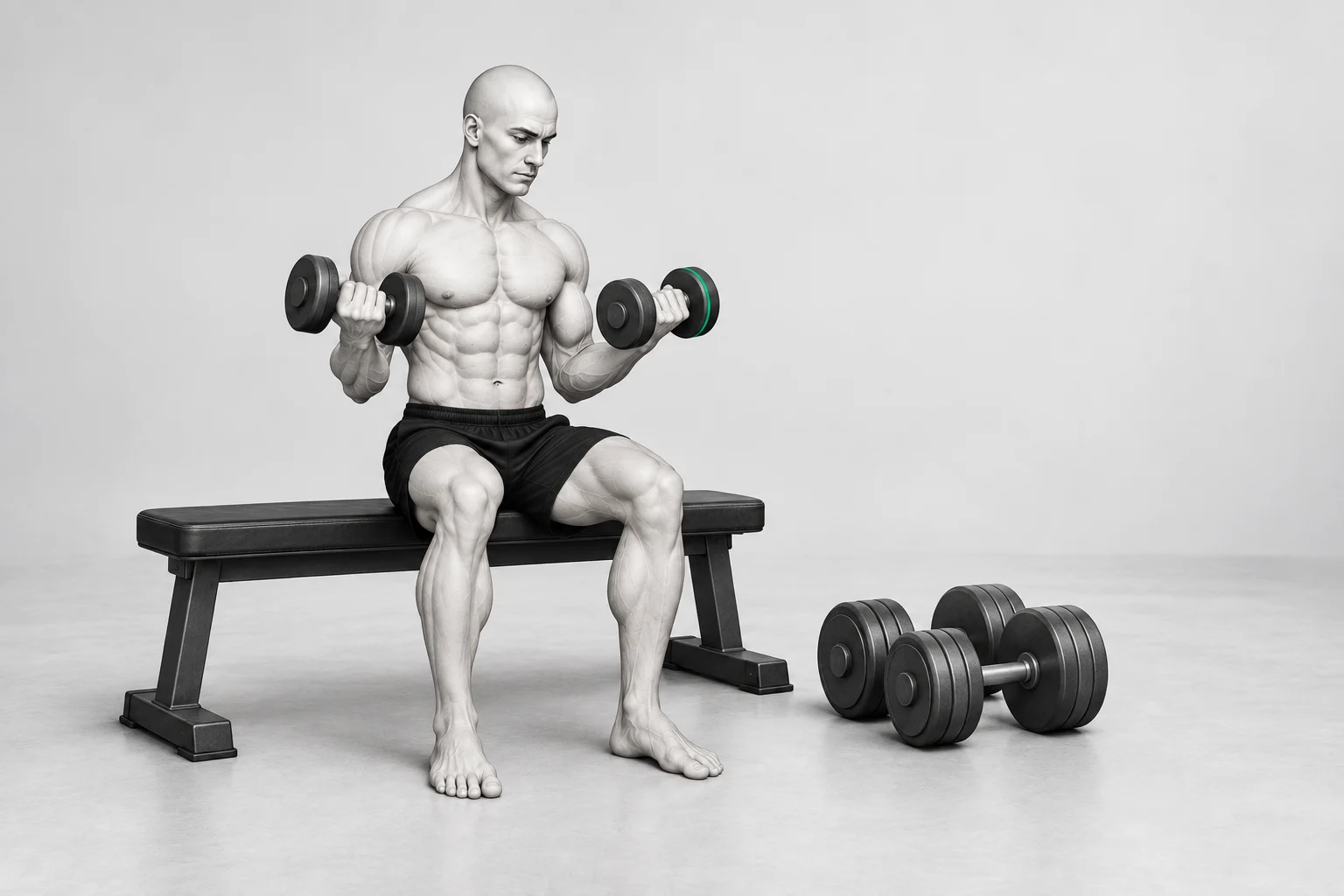
After warming up, use an exercise you know well. Prepare two loads that allow you to switch without rushing. A hypothetical curl example: perform 10 reps with a 10 kg dumbbell in each hand, set the pair down, pick up the 8 kg pair and complete 6 more controlled reps. Then end the sequence.
The reduction is (10 − 8) ÷ 10 × 100 = 20%. It describes this example, not an optimal percentage. Those 10 + 6 = 16 reps use two different weights: do not log them as 16 reps at 10 kg. The rep counts are not targets to force.
Research protocols often use muscular failure. For a first trial, do not turn that into an obligation to fail a rep: stop when the next rep would require cheating. If technique breaks down at the start of the second stage, use less weight next time or return to traditional sets.
Which exercises work well for drop sets?
The dumbbell curl with a lighter pair ready, the machine preacher curl and machine lateral raises are practical options if you can perform them and adjust the load correctly. This is not a list of scientifically superior exercises.
On a machine, fully settle the weight before moving the pin and follow the manufacturer’s instructions. Never adjust a moving weight stack. With dumbbells, put the first pair down under control: “drop” does not mean throwing the equipment.
Avoid learning the method on a heavy free bar that requires assistance or a complicated setup to unload. Your equipment choice should make stopping easy, not turn the exercise into a race against the clock.
How can you test it without adding work everywhere?
Do not automatically add a drop set to every final set. To test time savings, replace a clearly identified block rather than adding work throughout the workout. A drop set does not automatically equal two or three traditional sets: no single conversion covers every exercise and effort level.
Record each stage using the principles in the workout log guide. Keep a separate record of the format and total time, including rest and transitions. Then compare the same exercise in the same place in the workout with the same number of reductions.
Keep the method if it genuinely frees up time and your following workouts remain manageable. If range of motion shrinks, the effort puts you off or performance consistently worsens, return to traditional sets. There is nothing to make up for: drop sets are an organizational option, not a requirement.
Sources and methodology
The recent synthesis and original trial were read in full. Small samples, differing protocols and short study durations limit the conclusions. The numerical example and selection criteria are practical suggestions, not universal prescriptions.
Frequently asked questions
Should you use drop sets in every workout?
No. Use them only when they meet a specific time or scheduling need. Consistently tracked traditional sets remain an effective foundation.
How much should you reduce the weight?
There is no required percentage. Choose an available reduction that lets you continue cleanly; the example’s 20% reduction is not a proven optimal dose.
Does one drop set count as three sets?
Not automatically. Record the sequence and each of its stages, then use a consistent convention when comparing workouts. Do not assume an exact equivalence with sets separated by rest.
Can you start lifting with this method?
It is simpler to first learn the exercises, load selection and when to stop a traditional set. Then try a drop set on a familiar movement without rushing the equipment change.