What is the difference between a superset and a straight set?
In straight sets, you complete a set, recover, and then repeat the same exercise. A superset pairs two exercises with little or no rest between them; the main rest period comes after the pair.
The difference is how rest is organized, not a new way to count sets. Three rounds of a press and three rounds of a row still equal six working sets. A superset mainly increases training density: more work in less time.
A meta-analysis of 19 studies involving 313 participants found a similar number of reps and volume load on average, with better time efficiency. It also found higher perceived exertion. Most studies examined acute responses in young trained men, so long-term equivalence is supported by less evidence.
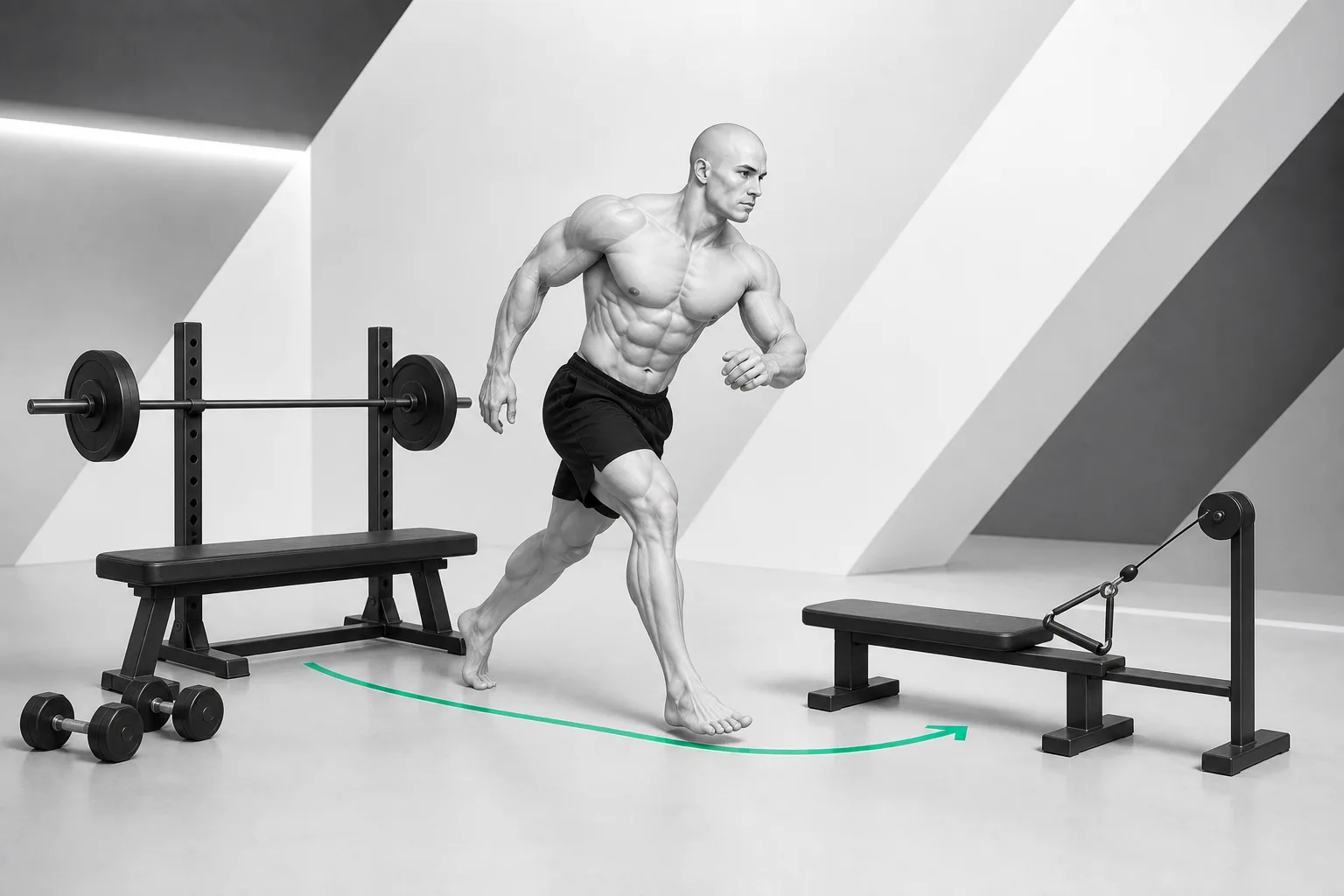
When should you choose supersets or straight sets?
| Situation | Preferred method | Why |
|---|---|---|
| Priority heavy lift | Straight sets | Preserve technique, force output, and full recovery |
| Accessory exercises for opposing muscles | Superset | Save time without immediately training the same muscle again |
| Two exercises for the same muscle | Straight sets by default | Pairing them is more likely to reduce reps or load |
| Short hypertrophy-focused workout | Hybrid format | Protect main lifts and increase accessory density |
| Learning a movement | Straight sets | Practice technique without added breathlessness or transitions |
What the evidence shows: supersets generally shorten a workout and can preserve total work when they are programmed well. Practical guideline: keep straight sets for the exercises where performance matters most. What depends on you: the available equipment, your tolerance for exertion, and the consistency of your reps.
Which exercises should you pair in a superset?
Opposing-muscle pairings are the easiest to program: press with pull, flexion with extension. The meta-analysis found that these pairs preserve volume better than two biomechanically similar exercises for the same muscle. A crossover study in 14 trained men also found that an antagonist row performed well short of failure between bench-press sets did not reduce bench-press velocity; this describes an acute response, not a guarantee for every pairing.
- chest and back: dumbbell bench press then one-arm dumbbell row ;
- quadriceps and hamstrings: leg extension then seated leg curl ;
- biceps and triceps: supinated dumbbell curl then cable triceps pushdown.
You can also alternate upper- and lower-body exercises. In a six-week study in 17 moderately trained men, alternating squats and bench presses with moderate loads and low velocity loss produced similar strength gains in less time. This does not mean you should pair two heavy free-weight lifts close to failure: the protocol was tightly controlled.
How do you build an effective hybrid workout?
- First place the movement that serves your main goal by following the guide to exercise order.
- Perform its straight sets with rest periods long enough to preserve the planned technique and load.
- Then pair two accessory exercises that do not directly interfere with each other and use nearby equipment.
- Move from A to B with only enough time to change position, then rest 1 to 2 minutes after the pair. Add more rest if reps or range of motion decline.
- Keep the same number of working sets at first and check it with the weekly volume calculator.
- Log A and B separately in your workout log.
Recalculated example: two exercises for three sets each, with 90 seconds after each of the first five sets, include 7 minutes 30 seconds of planned rest in a straight-set format. Three pairs with 90 seconds after the first two include 3 minutes of planned rest. Execution time and transitions must be added in both cases.
How can you tell whether a superset hurts performance too much?
Test the same pair for three workouts before drawing a conclusion. Keep the rep range, starting loads, A–B order, and a comparable RIR. Then compare each exercise with your latest straight sets.
- if reps stay in the planned range with stable technique, the superset is doing its job;
- if the second exercise regularly falls below the range, add 30 to 60 seconds before starting it;
- if the first exercise declines from round to round, extend the rest after the pair;
- if breathlessness stops the set before the target muscle does, choose a less demanding pair;
- if priority performance stays lower across several workouts, return that exercise to straight sets.
In a study of 30 untrained adults completing a full workout, supersets reduced workout duration but also lowered total reps by 4.6%, with higher perceived exertion and heart rate. This acute result is specific to sets taken to failure; it mainly shows why individual tracking remains necessary.
Which superset mistakes should you avoid?
- turning every heavy exercise in the workout into a superset;
- pairing two movements that heavily tax the same muscles without accepting a performance drop;
- placing the priority exercise second in the pair;
- choosing two distant or unavailable stations in a busy gym;
- shortening rest after the pair while reps are already falling;
- directly comparing superset loads with straight-set loads without recording the format change.
A superset is not better just because it feels more intense. Its value comes from saving time while preserving a level of work and execution you can repeat. If you have enough time and strength on a specific movement is the priority, straight sets remain fully effective.
Sources and methodology
The evidence mainly supports the time efficiency of supersets. Strength and hypertrophy adaptations appear similar when volume is comparable, but the meta-analysis included only a few longitudinal studies, so the practical recommendations remain cautious.
Frequently asked questions
Do supersets build less muscle than straight sets?
That is not what the available evidence shows when volume and effort are comparable. However, long-term studies remain limited, and a superset that costs many reps can reduce the work you actually complete.
How long should you rest in a superset?
Move from the first to the second exercise with little or no rest, then start with 1 to 2 minutes after the pair for accessory work. Extend that rest if technique, reps, or load no longer hold up.
Can you superset two exercises for the same muscle?
Yes, but this pairing creates more fatigue in the same muscle and is more likely to reduce volume load. Use it as a targeted technique, not the default time-saving option.
Can beginners use supersets?
Yes, on simple, stable exercises once they understand the technique. Beginners often benefit from first learning each movement with straight sets, then pairing two accessory exercises without taking every set to failure.
Should you superset squats and bench presses?
Not by default. A controlled study used this alternation with moderate loads and low fatigue, but two heavy free-weight lifts close to failure generally require straight sets and more recovery.