
An exercise is not a set
An exercise is a movement and its variation, such as the back squat. A set is a group of consecutive repetitions of that movement. Three sets of squats therefore count as one exercise, not three.
Exercise count describes the variety in a workout; set count describes part of the workload. Five exercises with two sets each add up to 10 sets. Three exercises with four sets each add up to 12: the shorter list can contain more work.
Do not count light preparatory sets as extra exercises. Read the guide to warm-up sets before an exercise to distinguish them from your planned working sets.
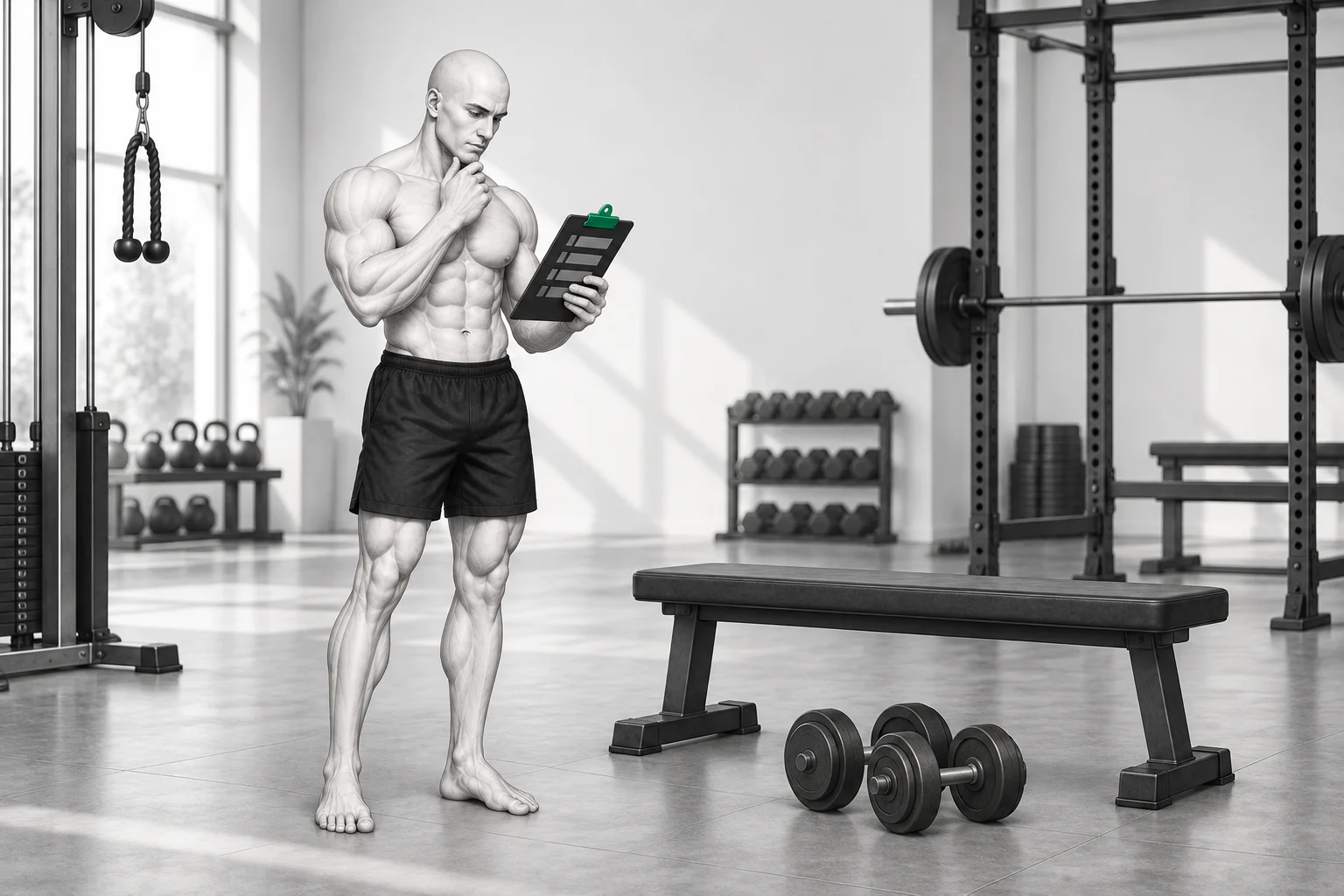
Is there an ideal number of exercises?
The evidence does not establish one number for every workout. The 2026 ACSM position stand, based on 137 systematic reviews, emphasizes progression and volume in healthy adults. It does not show that a list of six exercises is superior to a list of four.
A narrative review of time-efficient training proposes a short foundation: a leg movement, an upper-body push and an upper-body pull. This practical foundation does not mean that three movements maximize development of every muscle.
How to use this evidence: start with a manageable list, check muscle coverage and keep the exercises you can improve on. The range of 4–6 and the examples below are planning guidelines, not biological thresholds.
How do you choose movements without unnecessary overlap?
In a full-body workout, which trains both the upper and lower body, first make room for legs, a push and a pull. Then add a function or area that gets little work. A compound exercise involves several joints; an isolation exercise focuses movement more on one joint.
- A squat and a leg press are different exercises, but their roles can overlap. In a short workout, either one can fill the quadriceps slot.
- Three chest presses do not replace a pull for the back.
- A biceps curl is optional in a short list; add it if arms are a priority and the rest of your program allows it.
For a given muscle, a useful starting point is one main movement per workout, with a second complementary one if needed. Above all, check sets per muscle across the week : adding names does not guarantee a better training dose.
Beginner example: five exercises, ten sets
This example workout should be adapted to movements you know how to perform. The suggested reps help you choose a manageable weight; finish with a few reps still possible and rest long enough to repeat the technique.
| Role in the workout | Exercise option | Working sets |
|---|---|---|
| Legs: knee-dominant movement | Barbell back squat | 2 × 8–12 |
| Upper-body push | Machine chest press | 2 × 8–12 |
| Upper-body pull | Seated cable row | 2 × 8–12 |
| Back of the thighs | Seated leg curl | 2 × 10–15 |
| Calves | Standing machine calf raise | 2 × 10–15 |
The math is simple: 5 × 2 = 10 sets, split between several muscles. That is not ten sets per muscle. Repeating this workout twice gives 20 total weekly sets; the chest press, for example, provides four primary sets for the chest.
One possible sixth exercise is dumbbell lateral raises if shoulders are a priority. It is not mandatory. This workout does not illustrate every muscular function: distribute other useful movements across the week according to your goal.
Once you have chosen the exercises, use the guide to exercise order based on your priority to decide what comes first.
When should you add or remove an exercise?
- Keep the list if reps or weights are increasing with comparable technique, you recover well and the workout fits your schedule.
- Add an exercise if a priority area needs more work, you can explain what the new movement adds and you have time for its sets and rest periods.
- Remove an overlapping exercise if you consistently rush the last movements or have to shorten every rest period to finish.
- Look at sets before adding exercises if a muscle gets little work: an extra set on an existing movement can be simpler than adding another exercise.
Assess several comparable workouts before drawing a conclusion. One bad day does not prove that you are doing too many or too few exercises.
What if you only have time for three exercises?
Choose the day’s three priority roles, such as legs, pushing and pulling, and complete their sets without rushing. Cover missing areas in another workout. A short list solves a scheduling problem; you still need to review the whole week.
If your workouts focus only on the upper or lower body, you do not need to fill the slots of a full-body session. The right number depends on the muscles planned for that day and the work assigned elsewhere.
To turn these choices into a routine, the guide to what to record in your workout log explains how to keep a comparable history. Change one thing at a time: the exercise list, sets or weight.
Sources and methodology
Two reviews were read in full. They support principles of volume, progression and compact exercise selection; neither establishes a universal exercise count or validates this example as an optimal program.
Frequently asked questions
Are four exercises enough for a beginner?
Yes, this can be a useful start if the movements complement each other and any missing muscles are trained elsewhere in the week. Check sets and progress before extending the list.
Are eight exercises per workout too many?
Not necessarily. Eight exercises with few sets can be manageable, but beginners do not need eight for a workout to count. Reduce the list if roles overlap or you rush the end.
Do you need an exercise for every muscle in every workout?
No. Compound movements work several muscles, and workouts can complement each other. Review muscle coverage across the week, then add isolation work only when it serves a priority.
Does the warm-up count toward your exercise total?
Preparatory sets of the same movement do not add another exercise to your working list. Keep them separate from planned working sets to track the work you actually complete.