
What kind of results do you mean?
“Getting results” can mean performing exercises more confidently, lifting more weight or seeing more muscle. These goals are not measured in the same way. An easier workout is useful progress, but it does not tell you how much muscle you have gained.
For performance comparisons, use the guide to measuring strength-training progress. Here, the question is different: how much time should you allow after starting before judging visible changes?
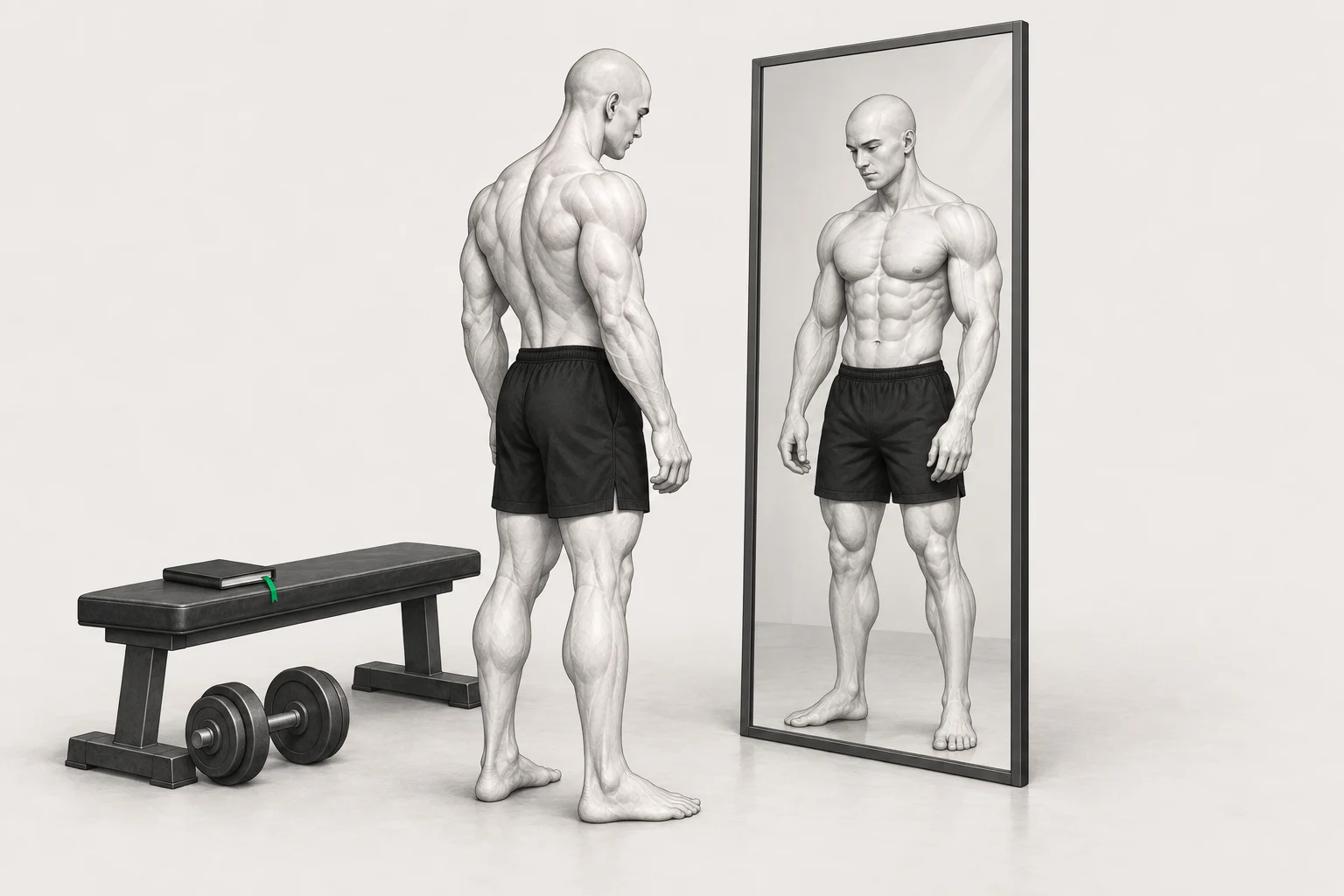
Why your lifts can improve before your appearance changes
In the study by Seynnes and colleagues seven young adults trained for 35 days on specialized equipment. Strength increased by day ten; increased muscle size was detected by MRI at day twenty. The small sample and specific protocol do not establish a timeline for visible results in everyone.
Do not turn a laboratory measurement into a before-and-after promise. You can learn the movement, handle the available weight better and gain confidence without a clear change in a photo. Conversely, a better photo alone does not prove your program has become more effective.
Does looking bigger already mean you have gained muscle?
A study by Damas and colleagues followed ten men who had not trained their lower body for at least six months. Muscle fibre size increased at ten weeks, not three. The authors note that early increases in muscle size may include swelling. This does not establish a universal starting point for muscle growth.
For your own review, avoid comparing a post-workout photo with one taken at rest. Keep lighting, distance, posture and timing similar. If photos are not helpful for you, you do not have to take them: your workout log remains an independent reference.
An 8–12-week first review: a guideline, not a promise
This timeframe is an organizational suggestion, not a proven threshold after which everyone looks more muscular. It gives you several weeks to establish the habit and collect more than a first impression. You may notice a change earlier, later or find it difficult to distinguish in a photo.
- At the start: record a realistic schedule and your initial weights, without chasing a record.
- During the first few weeks: mainly check that you complete your workouts and become more familiar with the exercises.
- At 8–12 weeks: review the workouts you actually completed, your performance trend and, if you wish, comparable photos.
Example: eight weeks with two planned workouts per week gives 8 × 2 = 16 planned workouts. If you complete twelve, you have followed 12 ÷ 16 × 100 = 75% of the schedule. This describes consistency, not 75% of an expected muscle gain. Use it to choose a more manageable schedule, not to blame yourself.
What if you still cannot see a change?
If your workouts are consistent and your performance is improving, the lack of an obvious mirror change is not enough to call the program useless. Keep watching the trend at your next review. Do not suddenly add workouts or sets just to meet an imaginary deadline.
If nothing is moving and your workouts are comparable, first check your working weight. Sets that always feel very easy are not the same as the intended effort. Correct one identifiable issue, then allow several workouts to evaluate it.
If your eating habits are inconsistent, also review your daily protein guidelines. Keep a consistent sleep schedule and a program that fits your daily life. If you are unsure what to adjust, ask a qualified trainer to review your approach instead of making many random changes.
Sources and methodology
Both original studies were read in full. They involve small groups of young adults and laboratory measurements, not the date when a transformation becomes visible in the mirror. The 8–12-week review and tracking suggestions are practical guidelines, not scientific guarantees.
Frequently asked questions
Can you see results after one month?
You may already perform exercises more confidently or improve your performance. A clear visual change in one month is not guaranteed. Do not confuse these two types of results.
Should you wait twelve weeks before adjusting anything?
No. Correct an unsuitable weight, setup or unmanageable schedule when needed. The 8–12-week review is about the overall picture, not an obligation to keep repeating a mistake.
Does more strength always mean more muscle?
No. Better performance means you are improving at the task. It does not directly measure how much muscle you have gained, especially while learning the exercises.
Should you take a photo every week?
It is not necessary. If photos are useful to you, compare them at your reviews under similar conditions. Frequent mirror checks are not a requirement for success.