What creates the appearance of a V-taper?
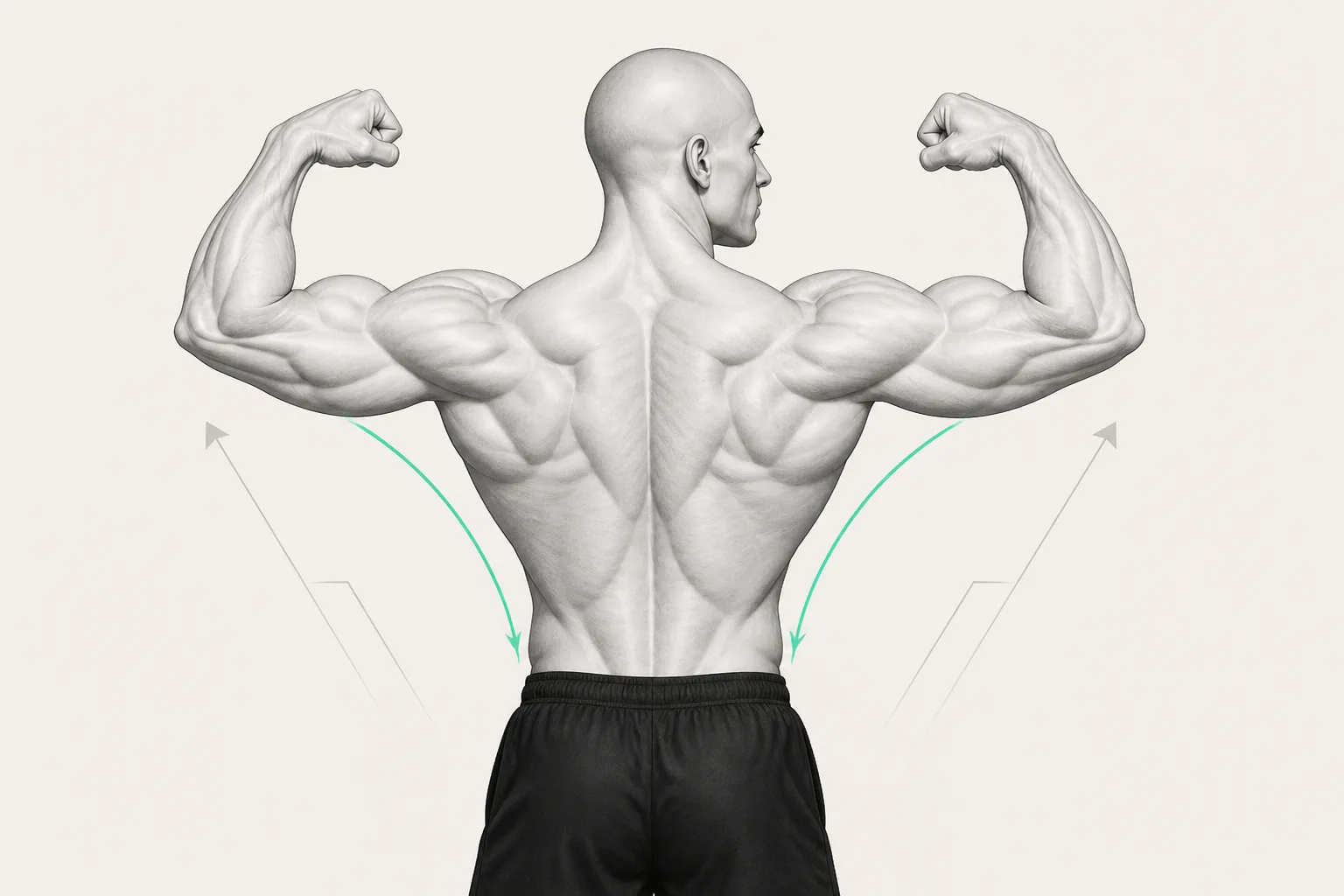
A V-taper combines broad shoulders, lats that flare beneath the armpits, and a visually narrower waist. Bone structure affects your starting proportions, but muscle development can significantly change the contrast.
The three main priorities are the lats, the side delts and clavicular head of the pectoralis major. The rear delts and upper back then add depth and create a sharper transition between the shoulders and torso.
Which muscles should you prioritize?
| Priority | Visual effect | Main movements |
|---|---|---|
| Lats | Add width beneath the armpits | Pull-ups, lat pulldowns, pullovers |
| Side delts | Broaden the shoulder line | Dumbbell, cable, or machine lateral raises |
| Upper chest | Adds fullness to the upper torso | Incline press, low-to-high cable fly |
| Rear delts | Adds width from the side and rear | Reverse fly, reverse pec deck |
| Upper back | Adds thickness and improves the transition | Chest-supported row, wide-elbow row |
How do you build wider lats?
Start with a vertical pull you can progress: assisted or weighted pull-ups, a chest-to-bar lat pulldown, or a converging machine pulldown. Then add a row with the elbow relatively close to the torso and, if useful, a pullover to train shoulder extension without the biceps becoming the limiting factor.
Keep your pelvis stable, let the shoulder blade move naturally, and drive the movement with your elbow. A controlled range of motion and measurable progression matter more than changing grips every workout.
How do you build wider shoulders and a fuller upper chest?
Lateral raises directly target the side delts. Dumbbell, cable, and machine variations can all work: choose the versions that feel comfortable and let you progress without turning the movement into a shrug. Find volume guidelines and variations in the guide to build wider shoulders.
For the upper chest, use a low-incline press, often around 15 to 30 degrees, and add a low-to-high fly if needed. The dedicated guide to the upper chest covers angles, exercises, and progression. A steeper incline shifts more work toward the front delts.
Sample two-workout V-taper program
This block can fit into a complete training week. It provides about 6 to 8 direct sets for the side delts and upper chest, plus 10 to 13 pulling sets for the lats and upper back.
| Workout A | Sets | Reps |
|---|---|---|
| Pull-ups or lat pulldown | 4 | 6-10 |
| Incline dumbbell press | 4 | 6-10 |
| Dumbbell lateral raises | 4 | 12 to 20 |
| Chest-supported row | 3 | 8-12 |
| Workout B | Sets | Reps |
|---|---|---|
| Lat pulldown, different grip | 3 | 8-12 |
| Incline machine press | 3 | 8-12 |
| Cable lateral raises | 3 | 12 to 20 |
| Reverse fly or reverse pec deck | 3 | 12 to 20 |
Adjust this volume to account for the work already in the rest of your program with the guide to weekly training volume.
How can you progress without constantly adding exercises?
Set a rep range. Once every set reaches the top of the range with stable technique, increase the load slightly and return to the lower end. For lateral raises, small load increases or a few extra reps are enough.
Keep the same core exercises for 6 to 10 weeks. You can vary an angle or piece of equipment between the two workouts, but avoid random changes that make progress impossible to track.
Should you train your core too?
Core training improves stability and force transfer, but it cannot remove fat specifically from the waist. The V-taper also depends on overall body-fat level, posture, and individual proportions.
Keep core training simple—bracing, controlled flexion, and anti-rotation movements—then focus most of your physique-oriented volume on the lats, side delts, and upper chest.
Sources and methodology
The selected sources cover exercise selection, planned variation, lateral raises, and training recommendations that support hypertrophy.
Frequently asked questions
Can you build a V-taper without pull-ups?
Yes. A cable or machine lat pulldown can replace pull-ups if you can control and progress it more effectively.
Do you need a lot of overhead pressing?
Not necessarily. Presses mainly train the front delts. To make the shoulders look wider, keep enough direct lateral-raise work.
What angle should you use for incline pressing?
A moderate angle, often between 15 and 30 degrees, is a good starting point for targeting the upper chest without turning the movement into an overhead press.
How long does it take to see a change?
Performance can improve within a few weeks, while a clear visual change generally requires several months of consistent progression, nutrition, and recovery.